

Teenage years bring exciting opportunities, new friendships, and greater independence. At the same time, they also introduce unfamiliar social situations that can feel confusing or overwhelming. Learning how to navigate these moments takes practice, and one helpful tool is the use of social stories for teenagers.
Originally developed to help individuals better understand social situations, social stories have become valuable resources for teenagers of all abilities. They provide clear, structured examples of what to expect, why certain behaviors are appropriate, and how to respond confidently in everyday situations.
Whether you’re a parent, teacher, counselor, or teenager looking for practical guidance, this article explains how social stories work, their benefits, and where they can be used. You’ll also find information about free social stories for high school students and social stories for teenagers with autism.
What Are Social Stories?
SSocial stories are short, easy-to-understand narratives that explain social situations from a clear, supportive, and structured perspective. They help teenagers understand what to expect in everyday interactions, making unfamiliar or challenging situations feel more predictable and manageable.
Rather than telling teenagers what they must do, social stories encourage understanding by explaining:
- What is happening
- Why it is happening
- What other people may be thinking or feeling
- Different ways to respond appropriately
- Positive outcomes that may follow
By breaking social situations into manageable steps, these stories reduce uncertainty and help teenagers feel more prepared. They often include reassuring language, realistic examples, and practical solutions that can be applied in everyday life.
Social stories are usually written in simple, age-appropriate language and focus on encouragement rather than correction. Instead of criticizing mistakes, they build confidence by helping teenagers understand social expectations while respecting their individual experiences and learning styles.
Social Stories for Teenagers
The Girl Who Stopped Comparing Her Life Online

Meera loved taking pictures.
She enjoyed capturing beautiful moments, sharing memories with friends, and discovering new ideas online. Like many teenagers, social media was a big part of her daily life.
Every morning after waking up, she checked her phone.
During breakfast, she looked through posts.
After school, she watched videos and checked updates from classmates.
At first, social media felt fun.
It helped her stay connected.
It helped her discover new hobbies.
It gave her inspiration.
But slowly, something changed.
Everyone Seemed Perfect Online
Meera followed many people from her school and several popular creators online.
Whenever she opened her feed, she saw pictures of people having amazing experiences.
Someone was traveling to beautiful places.
Someone was celebrating a major achievement.
Someone was sharing a perfect outfit.
Someone was posting about exciting events with friends.
The more Meera looked, the more she felt that everyone else had a better life.
She started asking herself:
“Why don’t I look like that?”
“Why don’t I have so many friends?”
“Why is my life not as interesting?”
She knew, logically, that people only shared selected moments.
But emotionally, it was difficult to remember.
Comparing Her Real Life With Other People’s Highlights
One weekend, Meera attended a family gathering.
Her cousin took many pictures and posted them online.
The photos looked cheerful and perfect.
Everyone was smiling.
The decorations looked beautiful.
The food looked amazing.
Later that evening, Meera opened social media and saw the pictures.
Many people commented:
“Looks like such a fun day!”
“Your family is amazing!”
But Meera remembered something different.
Before those pictures were taken, everyone was tired.
The preparation had been stressful.
Some family members had argued about small things.
Everyone had moments when they were not smiling.
The picture showed only a few seconds.
It did not show the entire day.
This made Meera think:
“Maybe online posts are not the complete story.”
Writers Resources
The Effect on Her Confidence
Despite knowing this, Meera continued comparing herself.
She started becoming more critical of herself.
She looked at other teenagers and noticed what they had instead of appreciating what she had.
She stopped enjoying some of her favorite activities because she thought they were not impressive enough to share online.
She loved painting, but she rarely painted anymore because she believed:
“Nobody would care about my artwork.”
She enjoyed reading, but she felt that reading was less exciting compared with seeing others attend events or travel.
Slowly, she began measuring her happiness by what received attention online.
A Conversation With Her Sister
One evening, Meera’s older sister noticed that she seemed unhappy.
“You have been spending a lot of time on your phone lately,” her sister said.
“I’m just checking things,” Meera replied.
Her sister looked at her carefully.
“Does checking things make you feel better?”
Meera stayed quiet.
Then she admitted:
“Sometimes I feel like everyone is doing better than me.”
Her sister sat beside her.
“Do you know something interesting?” she asked.
“What?”
“Many people you think have perfect lives probably look at someone else and feel the same way.”
Meera looked confused.
“But they look so happy.”
Her sister smiled.
“People usually share their best moments. They don’t post every difficult day, every mistake, or every insecurity.”
Seeing Social Media Differently
That conversation stayed in Meera’s mind.
The next day, she looked through her social media feed differently.
She noticed something.
Almost every post showed a special moment.
A birthday celebration.
A vacation.
An achievement.
A beautiful photograph.
Very few people shared ordinary days.
Nobody posted:
“I had a difficult exam today.”
“I felt nervous before my presentation.”
“I made a mistake and learned from it.”
“I spent the whole afternoon doing homework.”
Meera realized she had been comparing her everyday life with other people’s carefully selected moments.
It was not a fair comparison.
Taking a Small Break
Meera decided to make some changes.
She did not delete social media completely.
She simply created healthier habits.
Visual Art & Design
First, she stopped checking her phone immediately after waking up.
Instead, she started her morning with activities she enjoyed.
She drank water.
She stretched.
She listened to music.
She prepared for school without comparing herself to others.
She also unfollowed accounts that constantly made her feel negative.
Instead, she followed pages that inspired her creativity and learning.
Returning to Her Own Interests
With more time away from constant comparison, Meera returned to painting.
One afternoon, she created a painting of a sunset.
She did not make it because she wanted likes.
She made it because she enjoyed creating something beautiful.
Later, her friend saw it and said:
“This is really good. You should share your artwork.”
Meera smiled.
A few months earlier, she would have worried about whether people would like it.
Now she understood something important.
The value of her work did not depend on how many people noticed it.
Learning to Celebrate Small Wins
Meera also started appreciating small moments in her own life.
She celebrated:
Completing a difficult assignment.
Having a good conversation with a friend.
Learning a new skill.
Helping someone.
Spending time with family.
She realized that a meaningful life is not created only through big achievements.
Visual Art & Design
Small moments matter too.
Becoming a Better Friend
As Meera became more comfortable with herself, she also became more present with others.
During conversations, she stopped checking her phone constantly.
She listened more.
She enjoyed real-life experiences instead of worrying about how they would look online.
Her friends noticed the difference.
“You seem happier recently,” one friend told her.
Meera smiled.
“I think I stopped trying to live someone else’s life.”
Understanding That Everyone Has Struggles
One day, Meera saw a popular student from her school post about an achievement.
Everyone congratulated her.
Normally, Meera would have compared herself.
But this time, she remembered something.
That same student had once told her privately that she often felt stressed and worried about disappointing others.
The post showed success.
It did not show the pressure behind it.
Meera understood that everyone has challenges, even people who seem confident online.
Lesson From Meera’s Story
Social media can be enjoyable and useful, but it can also create unrealistic comparisons if we forget how it works.
Visual Art & Design
People usually share selected moments, not their complete lives.
A picture does not show someone’s worries.
A success post does not show someone’s struggles.
A happy video does not show every difficult day.
Instead of asking:
“Why is my life not like theirs?”
Try asking:
“What do I appreciate about my own life?”
Remember:
- Your journey does not need to look like someone else’s.
- Your achievements do not need online approval to matter.
- Your everyday moments are valuable.
- Your worth is not measured by likes, followers, or popularity.
The happiest people are not always those who have the most impressive online presence.
They are often the ones who learn to appreciate the life they are already living.
The Teenager Who Learned to Speak Up
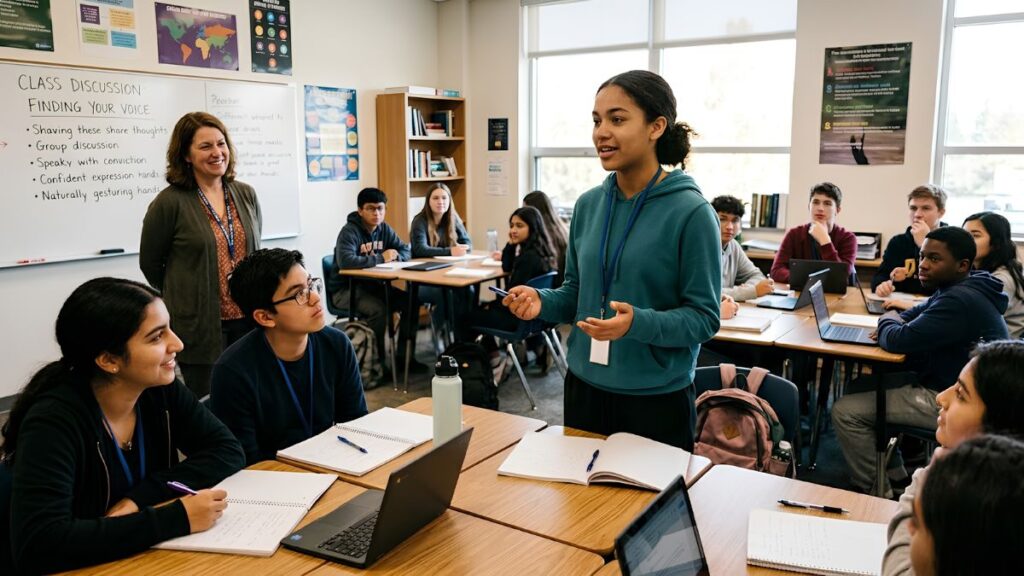
Aarav was the kind of student most teachers described as “quiet but thoughtful.” He was not shy because he disliked people. He enjoyed conversations, liked helping his classmates, and often had creative ideas. The problem was that he rarely shared those ideas.
Whenever he had something to say, a small voice inside his head would stop him.
“What if my answer is wrong?”
“What if everyone laughs?”
“What if people think my idea is silly?”
Because of these thoughts, Aarav usually stayed silent, even when he knew he could contribute something valuable.
At school, he was known as the student who always listened carefully but rarely raised his hand. During group discussions, he would write suggestions in his notebook but hesitate to speak. During conversations with friends, he often allowed others to lead while he simply agreed.
Most people around him did not realize how much he thought about things. They only saw his silence.
The Boy Behind the Silence
Aarav had always been a careful person.
Since childhood, he preferred observing situations before reacting. When his friends played games, he would notice the rules and strategies. When teachers explained topics, he would think deeply about how things worked.
His parents often told him:
“You notice things that other people miss.”
Aarav liked hearing that, but he still struggled to express himself.
At home, he was comfortable sharing his thoughts with his family. He could talk about movies, science, technology, and his hobbies for hours.
But school was different.
In school, he worried about how others saw him.
One day during a science class, his teacher asked a question about renewable energy.
“Can anyone explain why solar energy is becoming more popular?” the teacher asked.
Aarav immediately knew the answer. He had recently watched a documentary about solar panels and had read several articles about clean energy.
He slowly lifted his hand halfway.
Then he looked around the classroom.
Some students were already raising their hands confidently. Others were talking quietly.
Aarav lowered his hand.
A few seconds later, another student answered.
The answer was correct, but Aarav realized he had thought of an additional point that could have improved the discussion.
As he wrote in his notebook, he wondered:
“Why didn’t I just say it?”
Always Thinking, Rarely Speaking
This pattern continued.
During English class, Aarav had interesting interpretations of stories but kept them to himself.
Writers Resources
During mathematics discussions, he found easier ways to solve problems but waited for someone else to explain.
During group projects, he often completed his assigned work but avoided taking leadership roles.
His classmates sometimes misunderstood him.
“Does Aarav even have any ideas?” one student asked during a group activity.
The comment was not meant to be cruel, but it stayed in his mind.
The truth was the opposite.
Aarav had many ideas.
He just did not know how to share them confidently.
A New Challenge
One Monday morning, Aarav’s teacher announced a new assignment.
“The class will be divided into groups. Each group will prepare a presentation about solving a real-world problem.”
The students immediately started discussing topics.
Some groups chose environmental issues.
Others selected technology and education topics.
Aarav’s group decided to create a presentation about reducing food waste in schools.
The team included Aarav, his friend Rohan, and two other classmates, Meera and Kabir.
At their first meeting, everyone started sharing ideas.
“We should talk about how much food gets wasted in the cafeteria,” Rohan suggested.
“We can create posters encouraging students not to waste food,” Meera added.
Aarav listened carefully.
He had an idea.
He thought the presentation could include a simple mobile app concept where students could report extra food availability so others could use it.
He believed it would make the project more interesting.
But once again, hesitation appeared.
“They might think it is too complicated.”
“Maybe it is not a good idea.”
“Someone else probably has a better suggestion.”
He stayed quiet.
A Missed Opportunity
Over the next few days, the group worked on the presentation.
However, they struggled.
They had collected information but did not have a unique approach.
During a meeting, everyone looked frustrated.
“We have facts, but our presentation feels ordinary,” Meera said.
“We need something different,” Kabir agreed.
Aarav looked at his notebook.
His app idea was written on the page.
He had drawn a simple design showing how it could work.
He wanted to share it.
But fear stopped him again.
After the meeting ended, Rohan noticed that Aarav looked disappointed.
“You seem quiet today,” Rohan said.
“I’m fine,” Aarav replied.
Rohan smiled.
“You always say that.”
Aarav looked surprised.
“What do you mean?”
“I mean you always have something to say, but you keep it inside.”
Aarav did not know how to respond.
Rohan continued:
“I’ve noticed that. You write great ideas in your notes, but you never share them.”
A Small Conversation That Changed Everything
That evening, Aarav thought about Rohan’s words.
He opened his notebook and looked at all the ideas he had written but never shared.
He realized something important.
His problem was not that he had nothing valuable to say.
His problem was that he was waiting for a perfect moment when he would feel completely confident.
But maybe confidence did not come before speaking.
Maybe confidence came from speaking.
The next day, Aarav decided to try something small.
Not a huge speech.
Not standing in front of the entire school.
Just one idea in a group conversation.
During their next meeting, everyone was discussing how to improve the presentation.
Aarav took a deep breath.
“I have an idea,” he said.
The group became quiet.
For a moment, he felt nervous.
But he continued.
“What if we create a simple app concept that helps students share information about extra food in the cafeteria? It could reduce waste because students who need food can know when something is available.”
Writers Resources
There was silence for a few seconds.
Aarav immediately worried.
“They don’t like it.”
Then Meera smiled.
“That’s actually a really interesting idea.”
Kabir nodded.
“It makes our project different.”
Rohan smiled proudly.
“I knew you had something good.”
Aarav felt something he had not felt before.
Relief.
His idea was not perfect.
But it was useful.
And he had finally shared it.
Learning That Mistakes Are Normal
After that day, Aarav started practicing speaking more often.
He did not suddenly become the most talkative person in the class.
He was still thoughtful.
He still enjoyed listening.
But he started giving himself permission to participate.
During discussions, he raised his hand more often.
During group projects, he shared suggestions.
When he disagreed with someone, he respectfully explained his opinion instead of staying silent.
Sometimes his ideas were accepted.
Sometimes they were not.
At first, rejection still felt uncomfortable.
But Aarav learned something important:
Someone disagreeing with an idea did not mean the idea was worthless.
A conversation was not a competition.
Sharing thoughts was a way to learn from others.
The Day of the Presentation
Finally, presentation day arrived.
Aarav’s group stood in front of the classroom.
Normally, speaking in front of everyone would have made him extremely nervous.
His hands would shake.
His voice would become quiet.
But this time was different.
He was still nervous, but he was prepared.
When it was his turn to explain the app concept, he looked at the class and spoke clearly.
He explained the problem, the solution, and how students could benefit.
After the presentation, the teacher smiled.
“This was an excellent example of creative thinking,” she said.
“Everyone contributed well, but I especially appreciate how this group developed a practical solution.”
Aarav felt proud.
Not because he received praise.
But because he had allowed himself to be heard.
A New Version of Himself
Over the following months, Aarav continued improving.
He joined discussions.
He asked questions.
He volunteered for small responsibilities.
He even helped other quiet students share their ideas.
One day, a younger student told him:
“I have ideas, but I am afraid to say them.”
Aarav smiled because he understood exactly how that felt.
He replied:
“I used to feel the same way. But remember, an idea cannot help anyone if it stays only in your mind.”
Lesson From Aarav’s Story
Many teenagers struggle with confidence and fear of judgment. Being quiet does not mean you have nothing valuable to contribute.
Your thoughts, opinions, and ideas matter.
You do not need to become the loudest person in the room. Confidence is not about speaking all the time. It is about knowing when your voice can add something meaningful.
Start small.
Share one idea.
Ask one question.
Express one opinion.
Each time you speak, you become a little more confident.
Because finding your voice is not something that happens overnight.
It is something you build, one moment at a time.
The Friend Who Learned to Say No

Rohan always wanted to be liked.
He was the kind of person who enjoyed being around others. He loved laughing with friends during lunch breaks, playing games after school, and joining group activities. He believed friendships were one of the most important parts of teenage life.
But there was one thing Rohan struggled with.
He found it difficult to say no.
Whenever his friends suggested something, he usually agreed, even when he was uncomfortable. He worried that refusing would make people think he was boring, unfriendly, or different.
In his mind, keeping friends meant going along with whatever the group wanted.
For a long time, he did not realize that always saying yes was slowly making him ignore his own feelings.
The Need to Fit In
Rohan was not unpopular. In fact, many students liked spending time with him because he was kind and easy to talk to.
His closest friends were Arjun, Sameer, and Vikram.
They had been friends for years. They studied together, played sports, and shared jokes that only they understood.
Rohan valued their friendship a lot.
However, his friends were sometimes more adventurous than him.
They enjoyed trying new things, taking risks, and making spontaneous decisions.
Rohan often preferred planning ahead.
He liked completing homework on time.
He enjoyed following rules.
He felt comfortable with routines.
But he worried that admitting these things would make him seem less interesting.
So whenever his friends said:
“Come on, everyone is doing it.”
Rohan usually replied:
“Okay.”
Even when he wanted to say:
“No, I don’t think I should.”
The Small Decisions
At first, the situations seemed harmless.
One evening, his friends wanted to skip a study session and go to a gaming café.
“We can finish the work later,” Arjun said.
Rohan knew he had an important assignment due the next day.
He hesitated.
“I should probably complete my homework first,” he said.
His friends laughed.
“Relax, Rohan. You always take everything so seriously.”
He felt embarrassed.
He did not want them to think he was boring.
So he closed his notebook and joined them.
The next morning, he rushed to complete his assignment before class.
He felt tired and frustrated.
But he told himself:
“It’s okay. Friends are important.”
When Saying Yes Became a Problem
Over time, this happened more often.
His friends wanted to miss school activities.
They encouraged him to spend money on things he did not really want.
They made jokes about studying too much.
They pressured him to join conversations where he did not feel comfortable.
Each time, Rohan went along.
After all, he thought:
“If I say no, maybe they won’t invite me anymore.”
The strange thing was that even when he was with his friends, he sometimes felt lonely.
He was physically present, but he was not being himself.
The Important School Event
One month, the school announced a special career development workshop.
Students would meet professionals from different fields, learn about future opportunities, and participate in activities.
Rohan was excited because he wanted to learn more about different careers.
He registered immediately.
When he told his friends, Arjun smiled.
“You’re actually going to that?”
“Yes,” Rohan replied.
“It sounds interesting.”
Sameer laughed.
“Come on, that’s going to be boring. We are planning a trip to the mall that day.”
Rohan looked unsure.
The workshop and the trip were scheduled at the same time.
His friends started convincing him.
“Everyone is coming.”
“You can attend these things anytime.”
“It will be more fun with us.”
Rohan felt the familiar pressure.
He wanted to go with his friends.
He did not want to disappoint them.
But something inside him said:
“This is something important to me.”
A Different Choice
For the first time, Rohan stopped and thought carefully.
He asked himself:
“Am I choosing this because I want it, or because I am afraid of what others will think?”
The answer was clear.
He wanted to attend the workshop.
So he took a deep breath.
“I think I will go to the workshop,” he said.
The group became quiet.
Arjun looked surprised.
“You don’t want to come with us?”
“I do like spending time with you,” Rohan explained. “But this is something I really want to do.”
Sameer shrugged.
“Okay, your choice.”
The response was not as bad as Rohan expected.
Nobody stopped being his friend.
Nobody abandoned him.
The world did not end because he said no.
Discovering His Confidence
At the workshop, Rohan met students from different schools.
He listened to speakers talk about their careers and experiences.
He participated in activities.
He asked questions.
By the end of the day, he felt proud.
Not because the workshop was perfect.
But because he had made a decision based on what mattered to him.
He realized something important:
A good decision is not always the easiest decision.
Sometimes doing what is right for you requires courage.
Understanding True Friendship
A few days later, Rohan talked to his friends.
“I was worried you would be upset when I didn’t come with you,” he admitted.
Arjun smiled.
“Why would we stop being friends?”
Rohan looked surprised.
“I don’t know. I thought maybe you would think I was different.”
Arjun laughed.
“Of course you are different. We all are.”
That conversation helped Rohan understand something.
Friendship is not about agreeing with everything.
Real friends do not need you to copy them.
They respect your choices.
Learning to Set Boundaries
After that day, Rohan started practicing saying no.
Not in an angry way.
Not in a rude way.
Just honestly.
When his friends asked him to skip homework:
“I’ll join you after I finish my work.”
When someone pressured him to do something uncomfortable:
“No, I don’t want to do that.”
When he needed time for himself:
“I can’t today, but maybe another time.”
At first, it felt difficult.
But every time he respected his own choices, he became more confident.
Helping Others Understand Boundaries
Months later, Rohan noticed that another student in his class was facing similar pressure.
His classmate often agreed to things he did not enjoy because he wanted to fit in.
Rohan shared his experience.
“I used to think saying no would make people dislike me,” he said.
“But I learned that the right people will respect you for being honest.”
His classmate asked:
“But what if people leave?”
Rohan replied:
“Then maybe they liked your agreement, not the real you.”
Lesson From Rohan’s Story
Wanting to belong is a normal part of growing up. Teenagers often feel pressure to match their friends’ choices, opinions, or behaviors.
However, healthy friendships allow people to have different interests, opinions, and boundaries.
Saying no does not make you rude.
It does not mean you do not care about your friends.
It means you respect yourself and your decisions.
A true friend will not force you to become someone you are not.
Remember:
- You can be kind and still say no.
- You can be a good friend and have different choices.
- You can care about others while also caring about yourself.
The courage to say no is not about rejecting people.
It is about staying true to who you are.
The Day I Learned to Speak Up for Myself

Maya was the kind of person who noticed everything but rarely said much.
At school, she listened carefully during conversations, completed her assignments on time, and tried her best to be respectful toward everyone. Teachers often described her as responsible and hardworking.
However, there was one thing Maya found difficult: speaking up for herself.
If something bothered her, she usually stayed quiet.
If she did not understand a lesson, she often avoided asking questions.
If someone interrupted her while she was talking, she would stop speaking.
If she disagreed with a friend, she would simply say, “It’s okay,” even when it was not.
Maya thought staying silent was the easiest way to avoid problems.
She believed that speaking up might make people upset or think differently about her.
But slowly, she started noticing that always staying quiet created problems of its own.
When Silence Became Difficult
One afternoon, Maya was working on a group project with three classmates.
The group had to prepare a presentation for their science class. Everyone had different responsibilities.
At first, things seemed fine.
One student collected information, another designed the slides, and Maya was responsible for explaining one section during the presentation.
However, as the deadline approached, one of her classmates changed the plan without asking everyone.
“Maya, you can just do the entire presentation part,” her classmate said.
Maya looked surprised.
She had already completed her assigned work and had other assignments to finish.
She wanted to say:
“I don’t think I can do the whole presentation. We should divide the work equally.”
But instead, she smiled and replied:
“Okay.”
That evening, Maya spent several extra hours finishing the project.
She felt tired and frustrated.
She knew she had agreed to something she did not want to do.
Talking to Someone She Trusted
The next day, Maya’s older cousin noticed that she seemed stressed.
“You look worried. Is everything okay?” her cousin asked.
Maya hesitated.
She was used to keeping problems to herself.
Finally, she explained what happened with the project.
Her cousin listened carefully and said:
“Maya, helping others is a good quality. But helping does not mean ignoring your own needs.”
Maya thought about those words.
“I just don’t want people to think I’m rude,” she said.
Her cousin smiled.
“Expressing your feelings respectfully is not rude. It is called self-advocacy.”
“Self-advocacy means understanding what you need and communicating it clearly.”
Maya had heard people talk about confidence before, but she never realized that confidence was not about being the loudest person in the room.
It was about respecting yourself enough to speak when something mattered.
Learning That Her Voice Matters
Over the next few weeks, Maya started practicing small steps.
She did not suddenly become a completely different person.
She still felt nervous sometimes.
But she began making small changes.
During class, when she did not understand something, she raised her hand and asked:
“Could you explain that part again?”
The first time she asked, her heart was beating quickly.
But the teacher simply explained the topic again.
Nobody laughed.
Nobody judged her.
Maya realized that asking questions was not embarrassing.
It was a way of learning.
Saying No Respectfully
A few days later, a friend asked Maya to share her homework answers.
In the past, Maya would have immediately agreed.
She worried that saying no would hurt the friendship.
But she also knew that sharing completed assignments was not the right thing to do.
She took a moment and said:
“I’m happy to help you understand the questions, but I don’t think I should give you my answers.”
Her friend looked surprised.
For a moment, Maya worried she had made a mistake.
But then her friend said:
“Okay. Can we go through the difficult questions together?”
Maya smiled.
She learned that setting a boundary did not always damage relationships.
Sometimes, it created healthier ones.
Understanding Different Ways of Speaking Up
Maya learned that self-advocacy did not mean arguing or being aggressive.
There was a difference between:
Aggressive communication:
“You never listen to me.”
“You always make me do everything.”
Respectful communication:
“I would like to share my opinion.”
“I need some help with this task.”
“I am not comfortable with that.”
“I would prefer another solution.”
Speaking up was not about blaming others.
It was about sharing thoughts honestly and respectfully.
Handling Disagreement
One day, Maya and her friend disagreed about where to spend their weekend.
Her friend wanted to go somewhere crowded, but Maya preferred a quieter place.
Earlier, Maya would have simply agreed.
This time, she said:
“I understand why you want to go there, but I feel more comfortable somewhere less crowded. Can we find a place we both enjoy?”
Her friend listened.
They discussed different options and found a solution together.
Maya felt proud.
She realized that expressing her opinion did not create conflict.
It helped people understand her better.
Building Confidence Slowly
Maya discovered that confidence was like a skill.
The more she practiced, the easier it became.
She started using simple strategies:
Thinking before agreeing
Instead of immediately saying yes, she gave herself time to decide.
She learned to say:
“Let me think about it.”
“I’ll check and let you know.”
Using clear words
She avoided unclear answers when she had a different opinion.
Instead of:
“Maybe.”
“It’s fine.”
“I guess.”
She practiced saying:
“I would prefer…”
“I am not comfortable with…”
“I need some help with…”
Respecting herself
Maya learned that her feelings and opinions were important.
She did not have to apologize every time she expressed a need.
Helping Others Speak Up Too
As Maya became more comfortable expressing herself, she noticed something interesting.
Some of her classmates also struggled with speaking up.
One day, a quieter student in her group looked uncomfortable during a discussion.
Maya noticed and asked:
“What do you think about this idea?”
The student shared an opinion that actually improved their project.
Maya realized that when people feel comfortable sharing their thoughts, everyone benefits.
Speaking up was not only about helping herself.
It could also create space for others.
A New Understanding of Confidence
Months later, Maya looked back and realized how much had changed.
She was still a calm person.
She was still someone who listened carefully.
She was still respectful and kind.
But now, she understood that kindness did not mean staying silent all the time.
A person could be kind and have boundaries.
A person could be respectful and disagree.
A person could be quiet and still have a strong voice.
Lesson of the Story
Everyone deserves to have their thoughts, feelings, and needs respected.
Speaking up for yourself does not mean being rude or creating problems. It means communicating honestly and respectfully.
Teenagers often face situations where they need to make decisions, express opinions, set boundaries, or ask for help.
Learning self-advocacy can help young people become more confident, independent, and comfortable in their relationships.
Your voice matters.
You do not need to shout to be heard.
Sometimes, a calm and honest sentence is enough to show others who you are and what you need.
The Girl Who Learned to Speak Up

Maya was the kind of teenager who was always present but rarely noticed.
She attended every class, completed her assignments on time, and helped others whenever they needed something. Teachers often described her as responsible and polite. Her classmates thought she was friendly because she always smiled and agreed with everyone.
But there was something most people did not know about Maya.
She found it extremely difficult to speak up.
If she had a different opinion during a group discussion, she usually stayed quiet. If someone interrupted her, she would let them continue. If a friend asked her to do something she did not want to do, she often agreed just to avoid making them upset.
Maya believed that being a good person meant keeping everyone happy.
Over time, this became exhausting.
The Problem With Always Saying Yes
During her final year of school, Maya was assigned a major group project. The project required four students to research, create a presentation, and explain their findings in front of the class.
Her group members were excited, but soon Maya noticed something.
Two students were doing most of the talking, while another student, Arjun, rarely completed his assigned tasks.
Whenever the group discussed responsibilities, Arjun would say:
“Don’t worry, I’ll finish it later.”
Maya wanted to tell him that the deadlines were approaching, but she stayed silent.
She thought:
“Maybe he is just busy.”
A few days later, the group met again. Arjun still had not completed his part.
One of the group members looked frustrated.
“We need to divide the work properly. Otherwise, we won’t finish on time.”
Everyone looked at Maya because she had organized most of the project notes.
Maya knew what needed to be said.
She wanted to explain that everyone needed to contribute equally.
But she hesitated.
“What if they think I am being rude?”
“What if Arjun gets angry?”
“What if everyone dislikes me?”
So instead, Maya smiled and said:
“It’s okay. I can probably finish some extra parts.”
That evening, Maya spent several hours completing work that was not her responsibility.
She was tired, frustrated, and disappointed in herself.
She realized that avoiding a difficult conversation had created an even bigger problem.
A Lesson From Her Teacher
The next week, Maya’s teacher, Mrs. Sharma, noticed that she seemed distracted.
After class, she asked:
“Is everything okay? You seem quieter than usual.”
Maya hesitated but finally explained what had happened with the project.
“I just don’t like creating problems,” Maya said. “I don’t want people to think I’m difficult.”
Mrs. Sharma listened carefully.
Then she said something Maya remembered for a long time.
“Speaking up respectfully does not mean you are creating problems. It means you are communicating your needs.”
Maya looked confused.
“But what if someone gets upset?”
Mrs. Sharma smiled.
“Someone being unhappy with your opinion does not automatically mean you did something wrong.”
She explained that healthy communication was not about being aggressive or controlling. It was about expressing thoughts, feelings, and boundaries in a respectful way.
“You can be kind and still be honest,” she said.
That sentence stayed in Maya’s mind.
Learning the Difference Between Being Rude and Being Assertive
Maya decided to learn more about communication.
She discovered that there was a difference between being passive, aggressive, and assertive.
Being passive meant hiding your thoughts and always giving in to others.
Being aggressive meant ignoring other people’s feelings and forcing your own opinions.
Being assertive meant expressing yourself clearly while respecting others.
Maya realized she had spent years being passive because she thought it was the same as kindness.
But she learned something important:
Kindness does not require you to ignore yourself.
You can care about others while also caring about your own needs.
Her First Small Step
The next time her group met, Maya decided to try something different.
She felt nervous.
Her heart was beating faster, and she started thinking:
“Maybe I should just stay quiet again.”
But she remembered her teacher’s advice.
She took a breath and said:
“I think we need to review everyone’s responsibilities because the deadline is getting closer. I have completed my section, but I need everyone to finish their parts so we can submit a good project.”
The room became quiet for a moment.
Maya immediately worried.
“Was that too much?”
But then one of her classmates nodded.
“You’re right. I should finish my part today.”
Another student added:
“We should probably create a timeline.”
Maya was surprised.
She had expected an argument.
Instead, her honesty helped the group solve the problem.
Building Confidence Slowly
Maya did not suddenly become the most outspoken person in school.
She still felt nervous before difficult conversations.
She still wondered what others would think.
But she started practicing small changes.
When she disagreed with an idea, she shared her opinion politely.
When she needed help, she asked for it.
When she could not take on extra responsibilities, she explained why.
At first, these actions felt uncomfortable.
But slowly, they became easier.
She realized that confidence was not something people were simply born with.
It was something people developed through practice.
Handling Disagreement
A few weeks later, Maya experienced another challenge.
A friend asked her to help complete an assignment that the friend had ignored for several days.
In the past, Maya would have immediately agreed.
This time, she responded differently.
“I understand you need help, but I already have my own work to complete. I can explain the topic to you, but I cannot do the assignment for you.”
Her friend looked disappointed.
For a moment, Maya felt guilty.
She wondered if she had been selfish.
But later, her friend thanked her.
“You were right. I needed to take responsibility instead of depending on others.”
Maya learned that setting boundaries could actually improve relationships.
The Importance of Respecting Yourself
Over time, Maya noticed changes.
She felt less stressed.
She had more time for her own goals.
Her relationships became healthier because people understood her better.
She also noticed something interesting.
When she respected her own opinions, others started respecting them too.
She learned that people often follow the way you treat yourself.
If you constantly ignore your own needs, others may assume your needs are not important.
But when you communicate clearly and respectfully, you teach others how you want to be treated.
A Message for Teenagers
Many teenagers struggle with speaking up.
They may worry about:
Being judged
Losing friendships
Disappointing others
Creating conflict
However, having your own voice is an important part of growing up.
Speaking up does not mean arguing with everyone.
It does not mean refusing to listen.
It means sharing your thoughts honestly and respectfully.
A healthy conversation allows everyone to express their feelings.
Remember:
Your opinion matters.
Your feelings matter.
Your boundaries matter.
You can be a kind person without always saying yes.
You can support others without forgetting yourself.
You can respect people while also asking them to respect you.
Maya spent years believing that staying silent made her a better friend.
Eventually, she discovered something more important:
A true friend does not need you to disappear.
The people who value you will appreciate your honesty, your thoughts, and the person you are becoming.
Finding your voice may feel difficult at first.
But every time you speak up with kindness and confidence, you take one more step toward becoming the person you want to be.
The Boy Who Learned That Asking for Help Is a Strength

Kabir was known as someone who could handle things by himself.
At school, he was responsible, organized, and hardworking. He completed his assignments before deadlines, helped classmates when they needed notes, and rarely complained about anything.
His teachers often praised him.
” Kabir is very independent,” they would say.
His friends also admired him.
“You always know what to do,” they told him.
Kabir liked being seen as someone who had everything under control.
But there was one thing he struggled with.
He did not know how to ask for help.
Whenever he faced a problem, he believed he had to solve it alone.
In his mind, asking for help meant admitting that he was weak.
When Things Started Becoming Difficult
At the beginning of the school year, Kabir had many goals.
He wanted to improve his grades.
He wanted to participate in competitions.
He wanted to learn new skills outside school.
At first, everything seemed manageable.
He created schedules.
He made study plans.
He organized his time carefully.
But slowly, his responsibilities increased.
He had difficult assignments.
Exams were approaching.
He joined a science competition.
He also helped his younger brother with homework at home.
Every individual task seemed small.
But together, they became overwhelming.
Pretending Everything Was Fine
One evening, Kabir was sitting at his desk surrounded by books.
He had an important exam the next day.
Usually, he studied confidently.
But this time, he felt lost.
There were several topics he did not understand.
He looked at his notes and thought:
“I should know this already.”
“Everyone else probably understands it.”
“I just need to work harder.”
Instead of asking his teacher for help, he continued studying alone.
Hours passed.
He became more frustrated.
The more he struggled, the more he blamed himself.
A Friend Notices Something Different
The next day at school, Kabir’s friend Aarav noticed that something was wrong.
“You seem tired,” Aarav said.
“I’m fine,” Kabir replied quickly.
Aarav looked at him.
“You always say that.”
Kabir smiled slightly.
“It’s nothing. I just need to manage better.”
But Aarav knew Kabir well.
“You don’t have to handle everything alone,” he said.
Kabir became quiet.
He wanted to explain how stressed he felt.
But the words did not come out.
The Fear Behind Asking for Help
Later that day, Kabir thought about why he avoided asking for help.
He realized he had several fears.
He worried people would think he was not smart.
He worried teachers would think he had not worked hard enough.
He worried his friends would see him differently.
He believed successful people always knew what they were doing.
But he started questioning that belief.
Did successful students never struggle?
Did talented people never need guidance?
Did asking a question mean someone was incapable?
The more he thought about it, the more he realized the answer was no.
A Conversation With His Teacher
A few days later, Kabir decided to speak with his mathematics teacher.
It took him several minutes to gather courage.
After class, he approached her.
“Ma’am, can I ask something?”
“Of course,” she replied.
“I am having difficulty understanding some topics. I tried studying on my own, but I think I need some guidance.”
He expected disappointment.
Instead, his teacher smiled.
“I’m glad you asked.”
Kabir looked surprised.
“You are?”
“Of course. Asking questions shows that you want to learn.”
She explained that many students struggle silently because they think asking for help is a weakness.
“But learning is not about knowing everything immediately,” she said.
“It is about being willing to improve.”
A New Way of Thinking
That conversation changed Kabir’s perspective.
He started seeing help differently.
Help was not something people needed only when they failed.
Help was a tool that allowed people to grow.
Athletes had coaches.
Doctors worked with teams.
Scientists collaborated with others.
Successful people often asked questions and learned from others.
Why should students be any different?
Taking Small Steps
Kabir began practicing asking for help in small ways.
When he did not understand a lesson, he asked questions.
When he had too many responsibilities, he talked with his family.
When he felt stressed, he shared his feelings with trusted friends.
The first few times were uncomfortable.
He still worried about being judged.
But each positive experience made it easier.
He discovered that most people were willing to support him.
Helping Others Also Learn
A few weeks later, a classmate approached Kabir.
“I don’t understand this chapter. Can you explain it?”
Normally, Kabir would have simply explained the answer.
But this time, he asked:
“What part are you finding difficult?”
They worked through the problem together.
During the conversation, the student said:
“I was afraid to ask because I thought everyone else understood.”
Kabir smiled.
“I used to think the same thing.”
He realized many students had the same fear.
They were all pretending to be confident while secretly struggling.
Learning That Everyone Needs Support
Over time, Kabir became more comfortable admitting when he needed help.
He learned that different people could support him in different ways.
Teachers could provide guidance.
Friends could provide encouragement.
Family could provide emotional support.
Classmates could share ideas.
He also learned that helping others did not mean carrying all their problems.
Healthy support involved cooperation, not taking responsibility for everything.
A Difficult Moment
Near the end of the year, Kabir faced another challenge.
He had to give a presentation in front of the entire class.
Public speaking made him nervous.
In the past, he would have hidden his fear.
This time, he told his friend:
“I’m nervous about presenting.”
His friend replied:
“That’s normal. Everyone feels nervous sometimes.”
They practiced together.
Kabir improved.
On presentation day, he was still nervous.
But he felt prepared.
He realized something important.
Getting support did not remove every challenge.
It helped him face challenges better.
Becoming Stronger
By the end of the school year, Kabir had changed.
He was still hardworking.
He was still responsible.
But now he understood that independence did not mean doing everything alone.
Real strength included knowing when to seek support.
He no longer saw help as a sign of weakness.
He saw it as a sign of maturity.
Lesson From Kabir’s Story
Many teenagers believe they must solve every problem alone.
They may fear judgment or worry that asking for help makes them look weak.
But everyone needs support at some point.
Asking for help can show:
- Self-awareness
- Courage
- Responsibility
- A desire to improve
Remember:
You do not have to wait until a problem becomes overwhelming before reaching out.
A simple question can prevent confusion.
A conversation can reduce stress.
A request for support can lead to growth.
Strong people are not those who never struggle.
Strong people are those who recognize challenges and take the right steps to overcome them.
Asking for help is not giving up.
It is choosing to move forward.
Why Social Stories Matter During the Teenage Years
Adolescence is a time of rapid growth, change, and new experiences. As teenagers become more independent, they encounter a wider range of social situations that require communication, decision-making, and emotional awareness. While these experiences help build important life skills, they can also feel overwhelming or confusing at times.
During the teenage years, many young people begin experiencing:
- Greater independence
- New friendships
- Peer pressure
- Classroom expectations
- Team activities
- Part-time jobs
- Romantic relationships
- Social media interactions
- Increased personal responsibility
Each new experience brings opportunities to learn, but it can also create uncertainty. Teenagers may wonder how to start conversations, respond to disagreements, understand social cues, or make responsible choices in unfamiliar situations.
Social stories provide guidance before these challenging moments occur, allowing teenagers to approach them with greater confidence. By explaining what to expect and offering practical ways to respond, social stories help reduce anxiety, encourage positive decision-making, and build the social skills needed for everyday life.
Benefits of Social Stories for Teenagers
Using social stories consistently offers many benefits for teenagers as they navigate school, friendships, family relationships, and everyday responsibilities. By providing clear guidance and realistic examples, social stories help young people feel more prepared for a wide variety of social situations.
Reduces Anxiety
Knowing what to expect often decreases nervousness before unfamiliar situations. Whether it’s starting at a new school, joining a club, or attending a social event, understanding what may happen can make the experience feel less intimidating.
Instead of worrying about every possible outcome, teenagers can focus on realistic expectations and practical ways to respond.
Builds Social Confidence
Reading positive examples helps teenagers feel more prepared during real-life interactions. As they become familiar with different social situations, they gain confidence in their ability to communicate, solve problems, and make thoughtful decisions.
Confidence often grows through repeated exposure to familiar scenarios and successful experiences.
Encourages Empathy
Social stories explain how other people may think or feel in different situations. This encourages teenagers to consider perspectives beyond their own and understand how their words and actions can affect others.
Developing empathy supports stronger friendships, healthier relationships, and better teamwork.
Improves Communication
Social stories introduce respectful and effective ways to communicate with others. Teenagers can learn how to:
- Start conversations
- Ask questions
- Express opinions respectfully
- Handle disagreements calmly
- Listen actively
- End conversations politely
These communication skills are valuable both in school and in everyday life.
Supports Emotional Regulation
Social stories can demonstrate healthy ways to respond when experiencing strong emotions such as:
- Frustration
- Embarrassment
- Nervousness
- Anger
- Disappointment
By modeling calm and positive responses, they help teenagers recognize their emotions and choose appropriate coping strategies instead of reacting impulsively.
Common Situations Covered by Social Stories
One of the greatest strengths of social stories is their flexibility. They can be adapted to nearly any everyday situation that teenagers may encounter at school, home, in the community, or online. By preparing for these experiences in advance, teenagers can approach them with greater confidence and a clearer understanding of what to expect.
Popular topics include:
- Meeting new classmates
- Joining clubs
- Working on group projects
- Eating lunch at school
- Visiting new places
- Talking to teachers
- Asking for help when needed
- Handling criticism respectfully
- Managing conflict with peers
- Respecting personal space
- Online communication
- Social media etiquette
- Using public transportation
- Preparing for job interviews
- Participating in volunteer activities
- Demonstrating good sportsmanship
- Taking part in classroom discussions
Social stories can also be created for specific situations, such as attending a school dance, participating in a field trip, starting a part-time job, or adjusting to a new daily routine. Because they are highly customizable, they can address the unique needs and experiences of each teenager.
The goal is always preparation rather than perfection. Social stories help teenagers build confidence, make informed choices, and develop practical social skills that they can use in everyday life.
How Social Stories Help Build Independence
As teenagers grow older, they naturally seek greater independence in their daily lives. Learning to make decisions, solve problems, and communicate effectively are important steps toward becoming confident and responsible adults.
Social stories support this process by encouraging thoughtful decision-making instead of relying solely on adult reminders. By explaining social expectations and appropriate responses, they help teenagers develop the confidence to handle situations on their own.
For example, a social story might explain:
- How to organize school materials
- How to ask a teacher for clarification
- How to speak respectfully with coworkers
- How to introduce yourself in new environments
- How to make responsible choices when faced with challenges
Over time, repeated reading helps many teenagers internalize these behaviors. As the situations become more familiar, they are better equipped to apply these skills independently in school, at home, and within their communities.
Free Social Stories for High School Students
Social Stories for Teenagers With Autism
Characteristics of Effective Social Stories
Well-written social stories share several important characteristics that make them easy to understand and helpful for teenagers. They are designed to provide guidance in a supportive way, helping readers feel informed and confident rather than criticized or overwhelmed.
Effective social stories are:
- Clear and easy to understand
- Positive in tone
- Free from judgment
- Age-appropriate
- Realistic and relatable
- Encouraging and supportive
- Respectful of individual differences
- Focused on one situation at a time
Rather than emphasizing mistakes or telling teenagers what they have done wrong, effective social stories focus on practical solutions and positive choices.
They explain social expectations in a calm, reassuring manner and encourage readers to build confidence through understanding, practice, and experience. This supportive approach makes social stories a valuable tool for developing everyday social and life skills.
Writing Social Stories for Teenagers
Creating your own social story is often easier than people expect. The most effective stories focus on one specific situation and provide clear, supportive guidance without being overly complicated. By keeping the language simple and encouraging, you can help teenagers understand what to expect and feel more confident when facing new experiences.
Start with a specific situation.
For example:
“Starting a conversation with someone new.”
Then explain the following:
What Is Happening
Describe the situation in simple, straightforward language. Explain where it takes place and what the teenager can expect.
Why It Matters
Help the reader understand why the situation occurs and why learning to handle it is important.
What Others May Be Thinking
Introduce different perspectives by explaining that other people may also have thoughts, feelings, or concerns. This encourages empathy and reduces unnecessary worry.
Helpful Choices
Offer several appropriate responses that the teenager can choose from. Focus on practical actions instead of perfect behavior.
Positive Outcome
Finish the story with reassurance and encouragement. Remind the reader that doing their best is more important than being perfect.
Example Structure
A simple social story might look like this:
Situation
Tomorrow I will work with new classmates during science class. We will complete a project together, and everyone will have a chance to share ideas.
What I Might Feel
I may feel nervous because I don’t know everyone yet. It is normal to feel a little uncomfortable in a new group.
What Others Might Feel
Some classmates may also feel unsure or shy. They might be hoping someone starts a friendly conversation first.
Helpful Choices
- I can smile.
- I can introduce myself.
- I can ask someone’s name.
- I can listen carefully to others.
- I can share my ideas respectfully.
- I can be kind and patient, even if I feel nervous.
Ending
Everyone is learning together, and no one expects me to be perfect. By being respectful, listening to others, and trying my best, I can have a positive experience and become more comfortable working with new people.
Using Social Stories at Home
Social stories are just as helpful at home as they are in school. Parents and caregivers can use them to prepare teenagers for upcoming events, explain family expectations, and reduce anxiety before unfamiliar situations. Reading a social story together gives teenagers an opportunity to ask questions, discuss possible challenges, and feel more confident before the event takes place.
Parents can use social stories before situations such as:
- Family gatherings
- Vacations
- Doctor appointments
- Shopping trips
- Birthday parties
- Driving lessons
- College visits
- Meeting new relatives or family friends
- Learning new household responsibilities
Reading the story beforehand allows teenagers to mentally rehearse the experience, making it easier to respond calmly and confidently. Over time, this practice helps build independence and prepares them to navigate a variety of real-life situations with greater ease.
Using Social Stories in Schools
Using Social Stories in Schools
Schools are excellent environments for using social stories because students encounter a wide range of social interactions and daily routines. Teachers, counselors, and support staff can use these stories to prepare teenagers for classroom expectations, build social confidence, and encourage positive behavior in a supportive way.
Schools frequently incorporate social stories into:
- Counseling sessions
- Special education programs
- Advisory periods
- Life skills classes
- Transition planning
- Peer mentoring programs
- Social skills groups
Teachers can also create classroom-specific stories that reflect school routines and expectations, such as participating in group discussions, asking for help, respecting classroom rules, or preparing for school events. By using realistic examples that relate to students’ everyday experiences, social stories become more engaging and effective.
When used consistently, social stories can help teenagers feel more comfortable in the school environment, improve communication, and develop the confidence needed to handle both academic and social situations successfully.
Can Teenagers Write Their Own Social Stories?
Absolutely. In fact, many older students benefit from writing their own social stories because the process encourages self-reflection, problem-solving, and independent thinking. Creating a story allows teenagers to explore their thoughts and emotions while considering positive ways to handle future situations.
They might write about:
- A difficult conversation
- A successful experience
- A goal for the future
- A recent challenge
- A social situation they want to improve
- A new responsibility at school or home
Writing their own social stories promotes self-awareness while reinforcing positive strategies and healthy decision-making. It also gives teenagers a chance to recognize their progress, celebrate successes, and identify practical steps they can take when facing similar situations in the future. Over time, this practice can strengthen both confidence and social skills.
Tips for Making Social Stories More Effective
A few simple practices can make social stories even more effective and meaningful for teenagers. The goal is to create stories that are easy to understand, relatable, and useful in real-life situations. When used consistently, social stories become a valuable tool for building confidence and strengthening social skills over time.
Consider these tips:
- Focus on one situation at a time.
- Keep the language clear and age-appropriate.
- Read the story before the event whenever possible.
- Encourage discussion after reading.
- Update the story as circumstances change.
- Personalize details to match the teenager’s experiences.
- Reinforce successes instead of focusing on mistakes.
- Be patient and allow time for learning and practice.
Consistency helps teenagers become more comfortable applying what they have learned. As they encounter similar situations in everyday life, the lessons from social stories become more natural, helping them respond with greater confidence, understanding, and independence.
Common Misconceptions About Social Stories
Although social stories are widely used, several misconceptions still exist about who they are for and how they work. Understanding the facts can help parents, teachers, and teenagers use them more effectively.
Misconception 1: Social Stories Are Only for Young Children
Many people believe social stories are designed exclusively for young children. In reality, they can be highly effective for adolescents and even adults when they are written with age-appropriate language and realistic situations. Teenagers often face complex social challenges, and social stories can help them prepare for these experiences with greater confidence.
Misconception 2: They Are Only for Teenagers With Autism
While social stories for teenagers with autism are widely recognized and commonly used, they are beneficial for many other individuals as well. Teenagers who experience anxiety, ADHD, learning differences, or difficulty navigating unfamiliar social situations can also gain valuable guidance from social stories.
Misconception 3: Social Stories Are Meant to Correct Behavior
Another common misunderstanding is that social stories are designed to discipline or correct behavior. Their real purpose is to educate, prepare, and encourage. Rather than focusing on mistakes, they explain social expectations in a positive, respectful way and provide practical strategies for handling different situations.
Misconception 4: They Can Only Be Used in Special Education
Social stories are valuable for all students, not just those receiving specialized support. Many teachers incorporate them into general education classrooms to introduce new routines, prepare students for school events, improve communication, and encourage positive social interactions.
The Reality
Social stories are flexible, supportive tools that help teenagers better understand everyday situations, build confidence, and develop stronger social and communication skills. When tailored to the individual’s needs, they can benefit a wide range of learners and everyday life experiences.
Final Thoughts
Growing up involves learning how to navigate friendships, responsibilities, communication, and new experiences. While every teenager develops social skills at their own pace, social stories for teenagers provide a supportive and practical way to prepare for everyday situations.
Whether you’re looking for free social stories for high school students to use in the classroom or exploring social stories for teenagers with autism to support specific needs, these simple narratives can make unfamiliar situations feel more predictable and manageable.
When written with empathy, respect, and realistic guidance, social stories become more than educational tools. They help teenagers build confidence, understand others, strengthen relationships, and approach life’s challenges with greater independence.