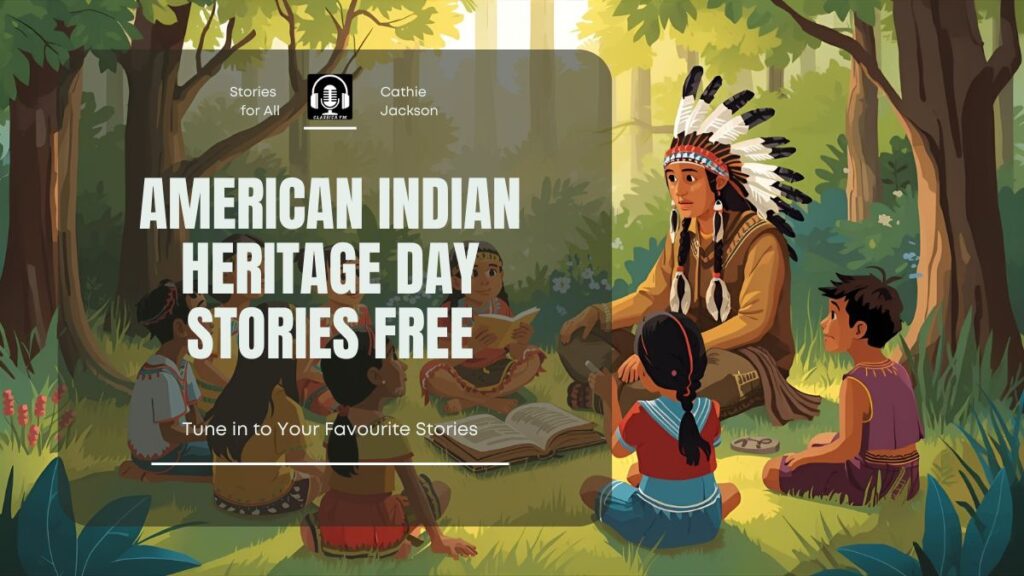
American Indian Heritage Day is an opportunity to introduce readers to the history, cultures, traditions, creativity, and experiences of American Indian peoples through meaningful storytelling. For children, families, educators, and anyone interested in Native American history and culture, stories can make historical and cultural subjects easier to understand while encouraging curiosity and respect.
Free American Indian Heritage Day stories can cover many subjects, from traditional values and community life to historical experiences, family traditions, nature, art, language, and the importance of preserving cultural heritage.
However, these stories should be created thoughtfully. American Indian peoples are not a single culture. Hundreds of distinct tribal nations have their own languages, histories, traditions, and contemporary communities. A good collection should avoid presenting Native cultures as one uniform tradition.
This guide explores what American Indian Heritage Day stories free can offer readers and how to approach these stories respectfully.
What Is American Indian Heritage Day?
American Indian Heritage Day is observed in the United States as a day recognizing American Indian heritage, culture, history, and contributions.
In many places, the observance is connected with the broader recognition of Native American Heritage Month in November.
The exact observance of American Indian Heritage Day can vary by state and community. Some states have designated a specific day, while schools, museums, libraries, tribal communities, and cultural organizations may organize their own events.
The purpose is generally broader than simply learning about the past.
It can be an opportunity to learn about:
- Indigenous history
- Tribal nations and communities
- Native languages
- Traditional arts and crafts
- Family and community relationships
- Indigenous environmental knowledge
- Contemporary Native American life
- Historical challenges and resilience
- Native American contributions to the United States
- Cultural preservation
Stories can help bring these subjects to life.
American Indian Heritage Day Stories Free
1. The Map Beneath the Floorboards
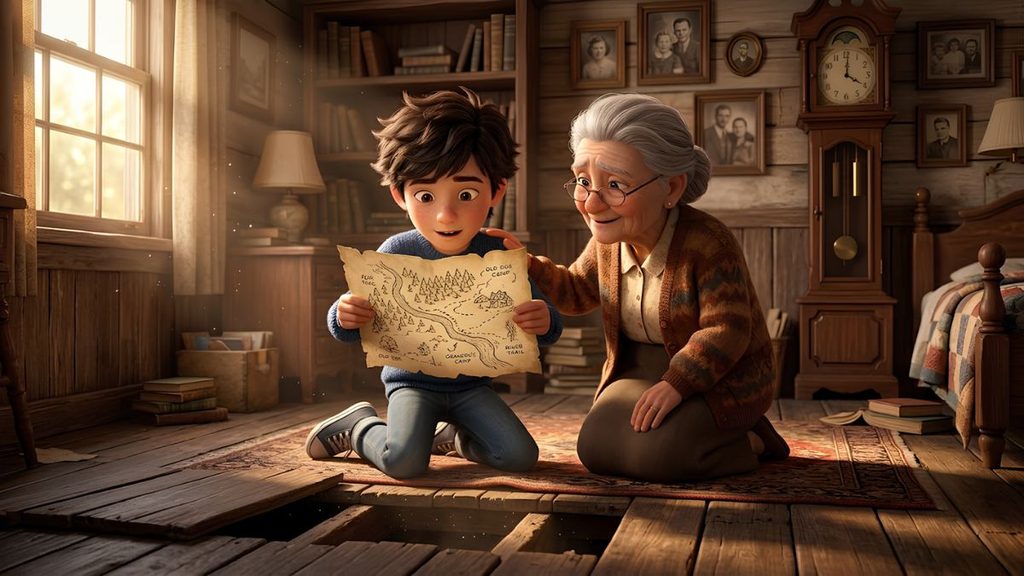
Type: Family History, Memory & Discovery
Caleb had always thought of his grandmother’s house as an old house.
Not a mysterious house.
Not a historic house.
And certainly not an interesting house.
It was simply the place where he spent many Saturday afternoons while his parents were busy with work.
The house stood at the end of a quiet road lined with tall trees. Its wooden porch creaked whenever someone stepped onto it, and the windows rattled slightly whenever the wind became strong.
Inside, everything seemed to have a story.
There was an enormous grandfather clock that had stopped working sometime before Caleb was born. There were framed photographs covering the hallway walls. There were shelves filled with books, old cooking utensils, handmade decorations, and boxes whose contents Caleb had never bothered to investigate.
His grandmother, Margaret, seemed to know where everything was.
“Don’t move that box,” she would say.
“Why?”
“Because I know what’s underneath it.”
“What’s underneath it?”
“Something else.”
Caleb had learned that this was usually the end of the conversation.
But one Saturday morning, the house was different.
His grandmother had decided it was time to renovate the upstairs hallway.
“The floorboards are getting worse,” she explained.
Caleb looked at the wooden floor.
“They look fine.”
His grandmother smiled.
“That’s because you’re twelve.”
“What does that mean?”
“It means you haven’t lived long enough to notice when a floor starts complaining.”
Caleb laughed.
His grandmother handed him a small screwdriver.
“You can help me remove the loose boards.”
Caleb immediately became interested.
Anything involving tools seemed more exciting than sitting around watching television.
For the next hour, they carefully removed several old boards.
Dust filled the air.
Caleb sneezed.
His grandmother laughed.
“Bless you.”
“Thanks.”
They continued working until Caleb noticed something underneath one of the boards.
It wasn’t a pipe.
It wasn’t a piece of wood.
It was a folded piece of paper.
“Grandma?”
She looked over.
“What is it?”
Caleb reached carefully into the narrow space.
“I don’t know.”
He pulled it out.
The paper was yellowed with age.
It had been folded several times, and the edges were worn.
Caleb unfolded it across the floor.
It was a map.
Not a proper map like the ones he had seen online.
There were no roads printed in neat lines.
Instead, someone had drawn everything by hand.
A river.
Several trees.
A hill.
A small building.
A footpath.
And several circles marked with tiny handwritten notes.
Caleb leaned closer.
“What is this?”
His grandmother had stopped smiling.
She stared at the map for several seconds.
Then she sat down.
“Where did you find that?”
“Under the floor.”
She reached for it.
Her hands trembled slightly as she held the paper.
Caleb noticed immediately.
“You know it?”
She nodded.
“I haven’t seen this in years.”
“Whose is it?”
“My father’s.”
Caleb’s eyes widened.
“Great-Grandpa Thomas?”
“Yes.”
Caleb had heard stories about Thomas many times.
He had died before Caleb was born.
From the photographs, Caleb knew him as a serious-looking man with thick eyebrows and a habit of standing with his hands behind his back.
But Caleb had never really thought of him as a young person.
“Did he draw this?”
“Yes.”
“What is it?”
His grandmother looked at the map again.
“It’s a map of places that mattered to our family.”
Caleb expected something more dramatic.
“A treasure map?”
She laughed.
“No gold.”
“Then what’s marked?”
“Memories.”
Caleb frowned.
“How can a map have memories?”
His grandmother pointed to a circle near a bend in the river.
“This was where your great-grandfather used to fish with his brother.”
She pointed to another.
“And this?”
“An old meeting place.”
“What’s that building?”
“The first community hall I remember.”
Caleb studied the map.
“Where are these places now?”
His grandmother folded the map carefully.
“Some are still there.”
“Can we find them?”
She looked at him.
“You want to?”
“Of course.”
That was how the adventure began.
The following Saturday, Caleb and his grandmother packed sandwiches, water, a notebook, and the old map.
Caleb also brought his phone.
“For photographs,” he explained.
His grandmother nodded.
“You’ll probably take more photographs than necessary.”
“I take good pictures.”
“You photograph your breakfast.”
“Breakfast deserves photographs.”
They drove toward the river.
The landscape looked ordinary to Caleb.
Fields.
Trees.
Houses.
Roads.
But when his grandmother compared the map with what she saw outside the car window, she became increasingly thoughtful.
“The river used to be closer to the road,” she said.
“Really?”
“Yes.”
“How do you know?”
“Because I remember.”
They stopped near an old walking trail.
According to the map, there had once been a large tree nearby.
Caleb looked around.
“I don’t see it.”
His grandmother pointed toward a wide stump surrounded by grass.
“There.”
Caleb walked over.
The tree must once have been enormous.
“How old was it?”
“Older than me.”
“That’s really old.”
She smiled.
“Not that old.”
They sat beneath the shade of another tree.
His grandmother began telling Caleb about the place.
When she was young, families would gather nearby.
Children played along the river.
Adults talked.
People brought food.
Someone always brought a musical instrument.
Caleb listened.
The place no longer looked ordinary.
It had become a scene from another time.
“Did Great-Grandpa bring you here?”
“Many times.”
“What did you do?”
“Mostly got muddy.”
Caleb laughed.
“Seriously.”
“Seriously.”
She told him about fishing trips, summer afternoons, family gatherings, and long walks.
Caleb wrote some of it in his notebook.
“Why did Great-Grandpa make the map?”
His grandmother thought for a moment.
“He wanted us to remember.”
“Remember what?”
“That places become part of families.”
Caleb didn’t completely understand.
His grandmother continued.
“When people move, buildings change, roads are built, trees disappear. But memories can disappear even faster if nobody tells them.”
Caleb looked at his notebook.
“So he made the map?”
“Yes.”
Their next stop was the old community hall.
Except it wasn’t really a hall anymore.
The building had been replaced decades earlier.
Caleb stared at the new structure.
“That’s it?”
“That’s where it stood.”
His grandmother pointed to a grassy area beside the current building.
Caleb checked the map.
The circle was there.
He took a photograph.
Then another.
His grandmother laughed.
“You don’t need twelve.”
“Maybe I do.”
“You don’t.”
Caleb put his phone away.
They walked around the area.
His grandmother told him about celebrations that had taken place there and people she remembered from her childhood.
Some names were familiar.
Others weren’t.
Caleb asked questions.
“What happened to them?”
“Some moved away.”
“Some?”
“Some passed away.”
Caleb became quiet.
His grandmother noticed.
“That’s why we remember them.”
The final location on the map was difficult to find.
It showed a small path leading toward a hill.
There was no road.
They parked nearby and walked.
After twenty minutes, Caleb began complaining.
“How much farther?”
His grandmother smiled.
“You’re twelve.”
“What does that have to do with anything?”
“You have a lot of energy.”
“I’ve been walking forever.”
“You’ve been walking twenty minutes.”
“Exactly.”
They continued.
Then Caleb saw something.
A stone wall.
Partly hidden by grass.
“Grandma!”
She hurried forward.
Her expression changed when she saw it.
“This is it.”
“What was here?”
She touched the stone.
“My grandfather’s house.”
Caleb stared.
“Your grandfather?”
“My father’s father.”
“Great-great-grandpa?”
She nodded.
“This was where our family lived before the current house.”
Caleb looked at the remaining stones.
There wasn’t much left.
No roof.
No windows.
No door.
Only fragments.
Yet his grandmother stood there as though she could see the entire house.
“I used to visit here with my father,” she said.
“What was it like?”
“Small.”
“Did you like it?”
She smiled.
“I loved it.”
Caleb sat on one of the stones.
“Why?”
“Because everyone was there.”
She began describing the house.
The kitchen.
The porch.
The garden.
The places where children slept.
The sounds of people talking.
The smell of food.
The laughter.
Caleb realized something.
The house was gone.
But his grandmother still carried it.
On the drive home, Caleb looked at the map again.
It seemed different now.
Before, it had looked like an old piece of paper.
Now every mark represented a story.
Every line connected people to places.
Every circle contained a memory.
“Grandma?”
“Yes?”
“Can I keep the map?”
She smiled.
“No.”
Caleb looked disappointed.
“But…”
“It’s yours eventually.”
“Eventually?”
“I want to keep it a little longer.”
“Okay.”
She reached into the back seat and handed him the notebook.
“But you can keep that.”
Caleb opened it.
He had written down everything they had discovered.
His grandmother looked at the pages.
“You’ve missed something.”
“What?”
“You.”
Caleb laughed.
“Me?”
“Yes.”
“What do you mean?”
She pointed to a blank page.
“You need to add your own place.”
Caleb thought about it.
“What place?”
“That’s for you to decide.”
Over the following weeks, Caleb began creating his own map.
He added the places they had visited.
He added photographs.
He recorded his grandmother’s memories.
He interviewed his parents.
He even called an older family member who remembered another location that wasn’t marked on the original map.
Slowly, the new map became larger than the old one.
But Caleb noticed something interesting.
His map wasn’t replacing his great-grandfather’s.
It was continuing it.
One afternoon, he showed his grandmother the finished version.
She studied it carefully.
“You’ve added quite a lot.”
“I had help.”
“From whom?”
“You.”
She smiled.
Caleb pointed to a new circle.
“That’s our favorite coffee shop.”
His grandmother laughed.
“That’s a very important historical site.”
“It is.”
“And this?”
“Grandpa’s garden.”
“And this?”
“Your house.”
She became quiet.
“Why did you mark this?”
“Because it’s where I learned all these stories.”
His grandmother placed a hand on his shoulder.
“Then it’s important.”
Caleb looked at the two maps.
One was old and fragile.
The other was new and colorful.
He suddenly understood what his grandmother had meant.
A family wasn’t only made from people.
It was also made from places, memories, stories, photographs, objects, conversations, and moments.
Some disappeared.
Others remained.
And sometimes, a simple map could keep them connected.
Months later, Caleb returned to the house.
The hallway floor had been repaired.
The loose boards were gone.
But his grandmother had saved the original hiding place.
The old map was now stored safely in a protective sleeve.
Caleb had added a note beside it.
“The map began with Great-Grandpa Thomas. It continues with us.”
His grandmother read it.
Then she smiled.
“You finally understand.”
Caleb nodded.
“I think so.”
She handed him the new map.
“Then keep drawing.”
And he did.
Because Caleb had discovered something that no history textbook had ever taught him.
History wasn’t always found in famous buildings or important dates.
Sometimes it was hidden beneath a floorboard.
Sometimes it lived in an old photograph.
Sometimes it waited inside a grandparent’s memory.
And sometimes, the most important map was the one that showed a family how to find its way back to itself.
2. The Museum Volunteer
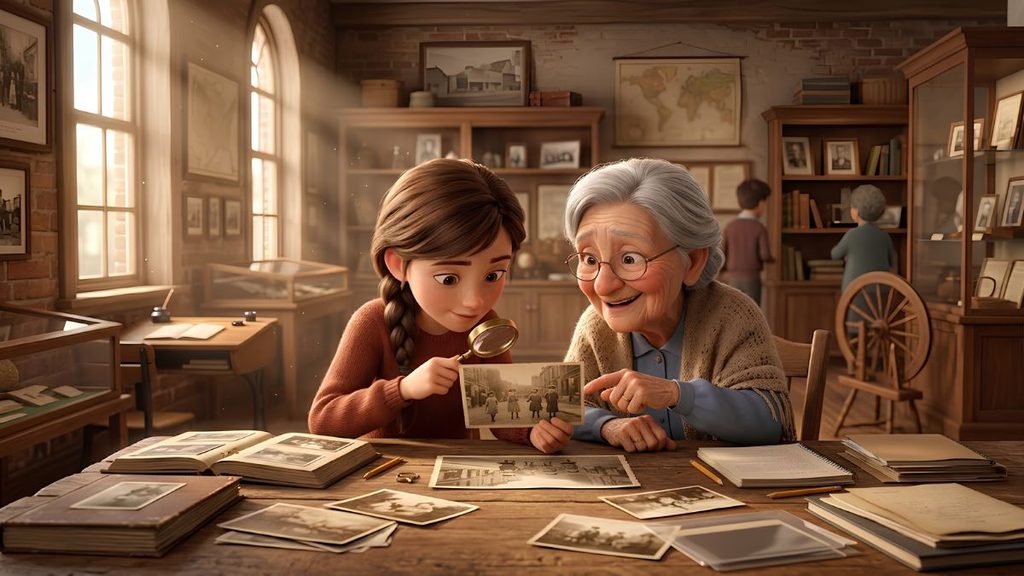
Type: Community Service & Historical Responsibility
Thirteen-year-old Maya Alvarez had expected her summer vacation to be much more exciting.
She had imagined sleeping late, riding her bicycle around town, meeting friends at the park, and spending long afternoons reading novels in the shade of the maple trees behind her house.
Instead, on the first Monday of June, she found herself standing inside the town’s little historical museum, staring at six cardboard boxes.
“Those are photographs,” said Mrs. Carter, the museum director.
Maya looked at the boxes.
“All of them?”
“All of them.”
Maya sighed quietly.
Mrs. Carter smiled.
“I heard that.”
“I wasn’t complaining.”
“You were thinking loudly.”
Maya smiled despite herself.
The museum was an old brick building near the center of town. It had once been a railway office, although Maya had never understood why anyone would want to preserve an old railway office.
Inside were glass display cases containing old tools, household objects, books, farming equipment, photographs, maps, and documents.
There was even an enormous metal cash register that looked as if it belonged in a movie.
Maya had volunteered because her mother thought it would be a good experience.
“You’ll learn something,” her mother had said.
Maya wasn’t convinced.
She opened the first cardboard box.
Inside were photographs.
Lots of them.
Black-and-white photographs.
Color photographs.
Small photographs.
Large photographs.
Some were carefully labeled.
Others simply had dates written on the back.
A few had nothing written at all.
Maya picked up one photograph.
It showed a group of children standing outside a wooden building.
She turned it over.
Nothing.
“Who are they?”
Mrs. Carter glanced at it.
“We don’t know.”
Maya looked surprised.
“You don’t know?”
“Not yet.”
“How can a museum have photographs of people and not know who they are?”
Mrs. Carter smiled.
“That’s exactly why you’re here.”
For the first few days, Maya performed ordinary volunteer tasks.
She dusted display cases.
She organized folders.
She helped visitors find information.
She carefully placed photographs into protective sleeves.
She labeled boxes.
It wasn’t exciting.
At least, that’s what she told herself.
One afternoon, however, Maya found herself looking again at the photograph of the children.
There were eight of them.
Four girls.
Four boys.
They stood in front of an old wooden schoolhouse.
One boy was holding a small metal lunch container.
A girl near the center wore a necklace.
Another child had a mischievous expression.
Maya stared at their faces.
“Someone must know who they are.”
Mrs. Carter looked over from her desk.
“Someone probably does.”
“Then why haven’t you found them?”
“Because history sometimes leaves us puzzles.”
Maya picked up the photograph.
“What if we solve it?”
Mrs. Carter smiled.
“Then we have our first project.”
Maya started with the photograph itself.
She examined the edges.
There was a faint handwritten mark in one corner.
It looked like a letter followed by a number.
She showed it to Mrs. Carter.
“Could this be a schoolroom number?”
“Possibly.”
They searched the museum’s records.
They found an old directory showing that the building had once been called Maple Grove School.
Maya searched through old school documents.
She found attendance registers.
But the names were incomplete.
Some pages were damaged.
Others were difficult to read.
“Look,” Maya said.
She pointed to one page.
“There was a class here in 1968.”
Mrs. Carter nodded.
“Yes.”
“Eight students?”
“Possibly.”
Maya compared the dates.
The photograph appeared to be from around the same period.
“How do we know?”
“We don’t.”
Maya frowned.
“So we need another clue.”
“Exactly.”
The next morning, Maya began examining other photographs.
She discovered a picture of the same school building taken from a different angle.
This photograph was labeled:
Maple Grove School, Community Picnic, 1969.
Maya looked closely.
The children in the photograph were older.
But several faces seemed familiar.
She placed the two photographs side by side.
“Mrs. Carter!”
The director walked over.
“What did you find?”
Maya pointed.
“Look at this girl.”
She compared the photographs.
“The girl with the necklace.”
Mrs. Carter leaned closer.
“I think you’re right.”
Maya felt a small burst of excitement.
“How do we find her?”
“We start with the records.”
They searched again.
This time, they found a list of students who attended Maple Grove School.
One name stood out.
Anna Redbird.
There was no photograph beside the name.
Maya wrote it in her notebook.
“Could she be the girl?”
“Perhaps.”
“But we shouldn’t say she is until we know.”
Mrs. Carter nodded.
“Good.”
Maya had learned something important.
Finding an answer wasn’t the same as making a guess.
They began contacting people who had grown up in the area.
Mrs. Carter knew several longtime community members.
Maya helped prepare a simple questionnaire.
She asked:
Do you recognize this school?
Do you recognize any of these children?
Do you remember attending Maple Grove School?
They printed copies and placed them on a table near the museum entrance.
They also asked permission to share the photograph through the museum’s community newsletter.
Days passed.
Nothing happened.
Maya began wondering whether they would ever identify anyone.
Then, one Thursday afternoon, an elderly woman entered the museum.
She carried a walking stick and wore a bright blue scarf.
She stopped when she saw the photograph.
“Where did you get that?”
Maya looked up.
“From the museum collection.”
The woman moved closer.
“That’s Maple Grove School.”
“Yes.”
The woman smiled.
“I went there.”
Maya’s eyes widened.
“Do you recognize anyone?”
The woman studied the photograph.
She pointed.
“That’s Samuel.”
Then another child.
“That’s Ruth.”
Then another.
“That’s Joseph.”
Maya hurried to her notebook.
“What about the girl with the necklace?”
The woman smiled.
“Anna.”
Maya nearly dropped her pencil.
“You know her?”
“Of course.”
“Where is she now?”
The woman laughed softly.
“You’re looking at her.”
Maya stared.
The woman pointed to herself.
“My name is Anna Redbird.”
Maya could hardly contain her excitement.
Mrs. Carter came over.
“Anna, would you be willing to tell us about the photograph?”
Anna smiled.
“I’d be happy to.”
She sat down.
Maya placed the photograph on the table.
“Where was this taken?”
“Outside the school.”
“Do you remember the day?”
“Not exactly.”
Anna thought for a moment.
“But I remember the lunch boxes.”
Maya laughed.
“The lunch boxes?”
“Yes. We had all brought food for a school picnic. Samuel’s lunch container was always bigger than everyone else’s.”
“Why?”
“Because his grandmother believed children needed to eat properly.”
Anna smiled.
She began identifying the other children.
She remembered who was always late.
Who loved drawing.
Who could climb trees.
Who hated rainy days.
Who always wanted to be first in line.
The photograph changed.
It was no longer simply a picture of eight unidentified children.
They had become people.
They had personalities.
They had stories.
Maya listened carefully.
Then she asked:
“Do you remember what happened to everyone?”
Anna became thoughtful.
“Some stayed here. Some moved away. Some became teachers. One became a doctor. Samuel ran a hardware store.”
“And you?”
Anna smiled.
“I became a librarian.”
Maya looked at Mrs. Carter.
“That’s perfect.”
Anna laughed.
Before Anna left, Maya asked one more question.
“Would you have any photographs from that time?”
Anna nodded.
“Perhaps.”
The following week, she returned with an old album.
Inside were photographs of Maple Grove School, family gatherings, community events, and children playing outside.
Maya and Mrs. Carter spent hours carefully comparing them with the museum collection.
They discovered more names.
More dates.
More stories.
One photograph showed a group of children building a small garden.
Another showed parents repairing the school roof.
Another showed a community picnic.
Another showed Anna holding a stack of books.
Maya began realizing that the museum wasn’t simply preserving objects.
It was preserving connections.
One afternoon, Maya discovered another photograph.
This one showed an older woman sitting outside a house.
There was no name.
Only a date.
Maya looked at it for a long time.
“Do you think we can identify her?”
Mrs. Carter smiled.
“Now you know what to do.”
Maya made a list.
She searched the museum database.
She checked old newspapers.
She examined directories.
She spoke with community members.
This time, she wasn’t bored.
She was curious.
Every photograph felt like a small locked door.
Behind it might be a name.
Behind the name might be a family.
Behind the family might be a story.
By August, Maya had helped identify dozens of photographs.
She created a simple system for the museum.
Each photograph received:
- A date when known
- A location
- Names of identified people
- Information about the event
- The source of the information
- Notes about anything still unknown
She also learned to distinguish between confirmed information and family memories.
If someone said, “I think that’s my uncle,” Maya wrote:
Possible identification, awaiting confirmation.
Mrs. Carter was impressed.
“You’ve become very careful.”
Maya smiled.
“I don’t want to put the wrong name on someone’s photograph.”
“That’s important.”
“Because once it’s printed, people might believe it forever.”
Mrs. Carter nodded.
“Exactly.”
One afternoon, Maya asked Anna why she had brought the old album to the museum.
Anna looked toward the photograph of the schoolchildren.
“When I was young, I thought photographs were just pictures.”
“And now?”
“Now I understand that they’re pieces of people’s lives.”
Maya nodded.
Anna continued.
“People remember famous events. Wars. Elections. Buildings. Important dates.”
She pointed toward the children.
“But ordinary people lived through history too.”
Maya looked at the photograph.
“Those children weren’t famous.”
“No.”
“But their lives mattered.”
Anna smiled.
“Exactly.”
At the end of summer, the museum held a small exhibition.
The title was:
Faces We Remember
The display included photographs that had previously been unidentified.
Beside each photograph were the names and stories that the museum had been able to recover.
The Maple Grove photograph occupied the center.
Eight children’s names appeared beneath it.
Maya stood nearby as visitors entered.
Anna arrived with several relatives.
She looked at the photograph and smiled.
For a moment, she seemed to become thirteen years old again.
Maya watched her carefully.
“Are you happy?”
Anna nodded.
“Very.”
“Why?”
“Because now nobody has to wonder who we were.”
A few minutes later, a young boy entered the exhibition with his father.
He stopped in front of the photograph.
“Who are they?”
Maya smiled.
“Children who went to school here a long time ago.”
“What were their names?”
Maya pointed.
“Anna. Samuel. Ruth. Joseph…”
The boy listened.
Then he asked:
“Are they still alive?”
“Some are.”
“Do they remember this?”
Maya looked at Anna across the room.
“I think they remember more than we ever could.”
The boy studied the photograph.
Then he smiled.
“That’s cool.”
Maya smiled too.
It was a simple word.
But she understood what he meant.
The photograph was no longer forgotten.
On her last day as a summer volunteer, Maya returned to the room where the cardboard boxes had once seemed so boring.
They were still there.
But she didn’t see ordinary boxes anymore.
She saw thousands of stories waiting patiently for someone to notice them.
Mrs. Carter handed her a small envelope.
“What’s this?”
“Your volunteer certificate.”
Maya opened it.
Inside was a photograph.
The Maple Grove children.
On the back, Mrs. Carter had written:
Thank you for helping us remember.
Maya looked at it.
“I didn’t do that much.”
Mrs. Carter shook her head.
“You asked questions.”
“That’s all?”
“Sometimes that’s where history begins.”
Maya smiled.
She put the photograph carefully into her notebook.
Before leaving, she walked through the museum one last time.
She passed the old cash register.
The railway maps.
The tools.
The books.
The photographs.
Everything seemed different now.
She finally understood something her mother had tried to explain months earlier.
History wasn’t only about famous people.
It wasn’t only about grand buildings or dramatic events.
History was also made of ordinary mornings, school lunches, friendships, family gatherings, childhood jokes, hardworking parents, community celebrations, and people whose names might otherwise disappear.
And sometimes preserving history meant nothing more complicated than looking at an old photograph and saying:
“I wonder who they were.”
Then caring enough to find out.
3. The Day the River Changed Course
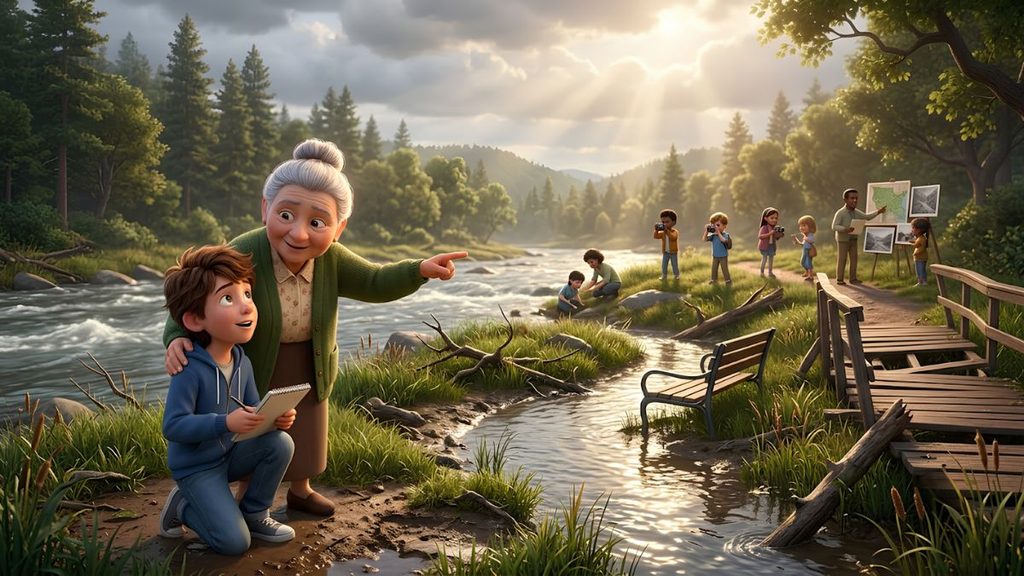
Type: Environmental Story
Noah had always believed that the river belonged to his town.
It wasn’t written anywhere, of course.
Nobody had ever officially said it.
But everyone in the neighborhood seemed to treat the river as though it were an old member of the community.
It flowed behind the houses, curved around the fields, passed beneath the old wooden bridge, and continued toward the distant hills.
People walked beside it.
Children rode bicycles along the trail.
Families sat beneath the trees on warm afternoons.
Fishermen arrived early in the morning.
Birds gathered along the shallow banks.
And Noah had spent much of his childhood beside it.
He knew where the water became shallow.
He knew where the trail became muddy after rain.
He knew which tree had a branch shaped like a question mark.
He even knew where his grandmother liked to sit when she wanted to watch the sunset.
“The river has been here longer than all of us,” she often told him.
Noah never thought much about that.
To him, the river simply was.
Until the storm.
It began on a Thursday evening.
The clouds appeared before dinner.
By sunset, the sky had become dark gray.
Wind moved through the trees.
Noah stood at the window watching leaves race across the yard.
“Big storm,” his father said.
“How big?”
“Big enough that you should stay inside.”
Noah groaned.
“I wasn’t going anywhere.”
His father raised an eyebrow.
“You were holding your bicycle helmet.”
“I was thinking about going somewhere.”
“Exactly.”
Rain began falling.
Within minutes, it was pounding against the windows.
Thunder shook the house.
Noah watched the trees bend in the wind.
The storm continued through most of the night.
When Noah woke the next morning, the world seemed strangely quiet.
Sunlight filled his bedroom.
He looked outside.
Branches were scattered across the yard.
Puddles covered the driveway.
Leaves were everywhere.
His first thought was the river.
He ran downstairs.
“Can we go see it?”
His grandmother was visiting that morning.
She looked at him over her cup of tea.
“Not yet.”
“Why?”
“The trail may be dangerous.”
“But I want to see how high the water is.”
“You’ll see it later.”
Noah sighed.
He knew that tone.
The discussion was finished.
By afternoon, the water had begun to settle.
His father agreed to take him to the river.
They walked slowly along the road.
When they reached the usual viewing point, Noah stopped.
Something was wrong.
Very wrong.
The river wasn’t where it was supposed to be.
“Whoa.”
His father said nothing.
A large section of the walking trail had disappeared.
Water flowed across the path.
A wooden bench was half-submerged.
Branches and debris covered the area.
But the strangest part was farther downstream.
The river had broken through its bank.
Instead of following its familiar curve, part of the water now flowed through a low grassy area.
Noah stared.
“Did the river move?”
His father nodded.
“Looks like it.”
“Can it do that?”
“Apparently.”
Noah’s eyes widened.
He was fascinated.
“This is amazing.”
His father looked at him.
“Maybe.”
“What do you mean?”
“It’s also dangerous.”
Noah looked again.
The river looked powerful.
It wasn’t simply flowing.
It was pushing against the landscape.
Moving soil.
Carrying branches.
Redrawing the edge of the land.
That evening, Noah told his grandmother everything.
“The river changed course.”
She looked at him.
“How much?”
He described the damaged trail and the new channel.
His grandmother became quiet.
“What?”
She smiled faintly.
“You sound surprised.”
“I am.”
“The river has changed before.”
Noah stared at her.
“When?”
“Long ago.”
“How long?”
“Before you were born.”
“Before Dad was born?”
“Yes.”
“Before you were born?”
She laughed.
“Much before.”
Noah sat beside her.
“How do you know?”
“Because people remembered.”
“Who?”
“My grandparents.”
She pointed toward the window.
“When I was a child, they told me about places where the river used to run.”
Noah frowned.
“Used to?”
“Yes.”
“I thought the river always followed the same path.”
“That’s what it looks like when you’re young.”
She walked to a cabinet and opened an old drawer.
Inside were photographs.
She searched through them.
Then she pulled out a faded black-and-white photograph.
“This.”
Noah took it.
It showed the river.
But something looked different.
The bank was farther away.
A large tree stood where the current trail now ran.
Noah looked from the photograph to his grandmother.
“That’s not how it looks now.”
“No.”
“Where was the river?”
She pointed.
“Right there.”
Noah looked at the photograph again.
“So it moved before.”
“Yes.”
“Why?”
“Rivers aren’t roads, Noah. They don’t always stay where we expect them to.”
The next morning, Noah returned to the river with a notebook.
His grandmother came too.
“So what are we doing?”
“Looking.”
“At what?”
“Everything.”
They stood beside the damaged trail.
Noah began writing.
Water level.
Trees damaged.
Trail covered.
New water channel.
His grandmother watched.
“You’re becoming a scientist.”
“I’m documenting it.”
“Good.”
Noah took photographs with his phone.
His grandmother showed him how to notice things he had never considered.
Where the water moved quickly.
Where it became shallow.
Where soil had washed away.
Where branches had collected.
Where birds had moved to higher ground.
She didn’t tell him what everything meant.
Instead, she encouraged him to observe.
“Look first,” she said.
“Understand second.”
Soon, other people became interested.
A local environmental group visited the river.
A teacher brought several students.
Town workers inspected the damaged trail.
Noah began helping wherever he could.
He didn’t touch dangerous areas.
He didn’t go near the fast-moving water.
Instead, he helped record information from safe locations.
One afternoon, his teacher brought an old collection of photographs.
“Your grandmother said you’re interested in the river.”
Noah nodded.
“Look at these.”
There were photographs from different decades.
The river appeared in different places.
The walking trail didn’t exist in some photographs.
Trees had disappeared.
New trees had grown.
A bend had become straighter.
An area that was once dry was now part of the river.
Noah couldn’t believe it.
“It’s always changing.”
His teacher smiled.
“Land changes. Rivers change. Communities change.”
Noah looked at the photographs.
“Then how do we know what the river will do?”
“We don’t know exactly.”
That answer surprised him.
“But we can observe it.”
Noah began creating a timeline.
He placed photographs in chronological order.
And now.
Each photograph showed the river in a slightly different position.
He noticed something.
The changes weren’t always dramatic.
Sometimes the river moved only a little.
A bank eroded.
A tree fell.
A bend widened.
Another became narrower.
But over many years, small changes added up.
The river wasn’t suddenly becoming different.
It had always been moving.
People had simply failed to notice because the changes happened slowly.
One Saturday, Noah and several other children helped clean debris from the safe parts of the walking trail.
Adults supervised.
They carried branches.
They collected litter.
They moved small pieces of debris away from the path.
Noah worked beside his friend Lucas.
“Do you think the trail will be the same again?”
“I don’t know.”
“What do you think?”
Lucas shrugged.
“Maybe the river decides.”
Noah laughed.
“That’s not very scientific.”
“It’s a river.”
“Fair enough.”
They continued working.
By lunchtime, the trail looked better.
But the damaged section remained.
The water now flowed through it.
Nobody knew whether the trail would be rebuilt in exactly the same location.
Noah realized that rebuilding everything exactly as it had been might not always be the smartest choice.
Sometimes the landscape itself was telling people something.
That afternoon, Noah sat with his grandmother beneath a large tree.
He showed her the timeline.
She studied it carefully.
“You’ve done good work.”
“I didn’t know the river had so many stories.”
“Everything has stories if you pay attention.”
Noah smiled.
“Did your grandparents know all this?”
“They knew some.”
“How?”
“They watched.”
She paused.
“They walked along the river. They noticed when trees disappeared. They remembered where the water used to be. They noticed changes because their lives were connected to the place.”
Noah looked toward the river.
“Is that different from science?”
His grandmother smiled.
“No.”
“No?”
“Observation is where science begins.”
A few weeks later, the town held a community meeting.
The damaged trail was discussed.
Some people wanted it rebuilt exactly where it had been.
Others believed the new river channel should be respected.
An environmental specialist explained that the river needed room to move.
Noah listened from the back of the room.
He wasn’t there to make the decision.
He was there to learn.
Then someone asked whether anyone had historical information about previous changes.
Noah looked at his grandmother.
She nodded.
Noah stood.
“I have photographs.”
Everyone turned toward him.
He walked to the front with his notebook.
He showed the old photographs.
One by one.
The room became quiet.
“This is from 1920.”
He showed another.
“1945.”
Another.
“1972.”
He explained how the river had gradually shifted over time.
He didn’t pretend to know what would happen next.
He simply showed what had happened before.
When he finished, the environmental specialist smiled.
“That’s excellent documentation.”
Noah sat down.
His grandmother whispered:
“You looked very serious.”
“I was serious.”
“I noticed.”
Months passed.
The town eventually redesigned part of the walking trail.
Instead of forcing it back into its old position, workers created a safer route farther from the river.
A small observation platform was built nearby.
There were signs explaining how rivers naturally change over time.
The old photographs became part of a community display.
Noah’s timeline was included.
His name wasn’t printed as the author.
He didn’t mind.
It wasn’t really his story.
It was the river’s story.
And the community’s story.
And the story of everyone who had watched, remembered, recorded, and cared.
One evening, Noah and his grandmother returned to the river.
The sun was setting.
The water reflected the orange sky.
Birds moved through the reeds.
The new walking trail followed a different path.
Noah stopped at the observation platform.
“It’s different.”
His grandmother nodded.
“Yes.”
“Do you miss the old trail?”
“A little.”
“Me too.”
They stood quietly.
“But,” Noah said, “I think I like this one.”
“Why?”
“Because now we know the river needs space.”
His grandmother smiled.
“That’s an important thing to learn.”
Noah looked at the flowing water.
“When I was little, I thought the river belonged to us.”
“And now?”
He thought about the photographs.
The storm.
The old stories.
The changing banks.
The new trail.
“I think we belong to the place too.”
His grandmother smiled.
“That’s better.”
That night, Noah added one final entry to his notebook.
He wrote:
The river changed course.
Then he paused.
He crossed it out.
Underneath, he wrote:
The river reminded us that it was never standing still.
He closed the notebook.
Outside, the river continued flowing.
It had no map.
No fixed line.
No promise to remain exactly where people expected it to be.
It simply followed the landscape, responding to rain, soil, trees, seasons, and time.
Noah understood now that caring for nature didn’t mean controlling it.
It meant paying attention.
It meant learning from what had happened before.
It meant listening to people who had watched the land for generations.
It meant using careful observation and modern knowledge together.
And sometimes, it meant accepting that nature would change.
The important thing was making sure people changed thoughtfully with it.
4. The School Project Nobody Expected
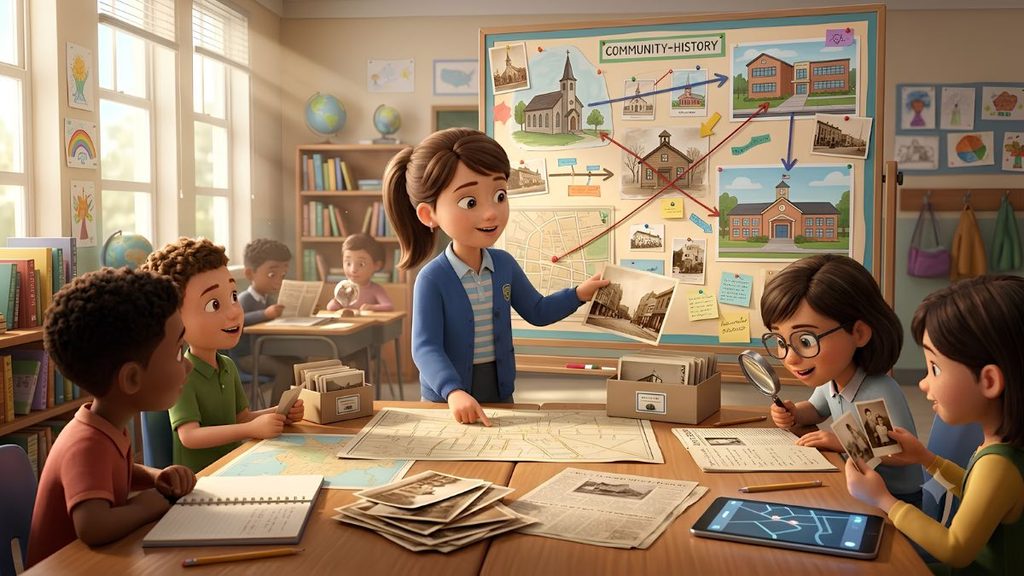
Type: Education & Challenging Assumptions
Ava Parker had already decided what her school project was going to look like.
It would be a poster.
A very good poster, she hoped.
It would have a large drawing of her town in the middle, a few photographs around the edges, and colorful arrows pointing toward the library, the school, the park, the fire station, and the bakery where her father sometimes bought cinnamon rolls on Saturday mornings.
At the top, she would write:
MY COMMUNITY
She thought that was exactly what her teacher wanted.
After all, everyone knew what their community was.
It was the streets where they lived.
The buildings they passed every day.
The school they attended.
The stores where their parents shopped.
The parks where they played.
Simple.
Finished.
Or so Ava thought.
On Monday morning, Mrs. Wilson wrote the assignment on the classroom board.
MY COMMUNITY
Underneath it, she added:
Where did it come from?
Ava raised her hand.
“Isn’t that just the history of the town?”
“Partly,” Mrs. Wilson said.
Ava looked confused.
Mrs. Wilson continued.
“This project isn’t about making the prettiest poster. I want you to investigate your community.”
“What are we supposed to investigate?”
“That is for you to discover.”
Ava wasn’t convinced.
Mrs. Wilson handed everyone a sheet of paper.
At the bottom were three questions.
Who lived here before the community looked the way it does today?
What names have changed?
Which stories are supported by evidence, and which are simply things people believe?
Ava stared at the page.
That wasn’t what she had expected.
“What does the last question mean?” she asked.
Mrs. Wilson smiled.
“It means that when you hear a story, you shouldn’t automatically assume it’s true.”
“Even if someone tells us?”
“Especially then.”
The class laughed.
Mrs. Wilson laughed too.
“But seriously,” she said, “research means learning how to ask good questions.”
That afternoon, Ava went home with a completely different idea for her project.
She put her backpack on the kitchen floor and announced:
“I’m investigating the town.”
Her mother looked up from preparing dinner.
“That sounds serious.”
“It is.”
“What are you investigating?”
“I don’t know yet.”
Her mother smiled.
“Then you’re already doing it correctly.”
Ava opened her notebook.
She wrote:
What was here before our town?
Then she stared at the question.
She had no idea.
Her first stop was the public library.
The librarian, Mr. Harris, knew Ava well.
“What brings you here?”
“A history project.”
“Good.”
“I need to know what was here before our town.”
Mr. Harris smiled.
“That’s a big question.”
“I know.”
He led her toward a section of local history books.
There were old maps.
Community histories.
Photographs.
Newspaper collections.
Directories.
Ava expected to find one book that explained everything.
Instead, she found dozens of pieces.
An old map showed a road that no longer existed.
A photograph showed a building that had disappeared.
Another map used a name Ava had never heard before.
She wrote it down.
Willow Creek District.
“What’s this?” she asked.
Mr. Harris looked at the map.
“An older name for part of the area.”
“Why don’t we call it that now?”
“Names change.”
“Why?”
“Sometimes roads are renamed. Sometimes neighborhoods are reorganized. Sometimes people adopt new names. Sometimes an older name remains in family memories even after official records change.”
Ava wrote that down too.
She discovered something else.
A small section of the town had once been marked differently on maps.
The land that now contained the school and sports field had once been outside the main settlement.
Ava found an old photograph showing the area decades earlier.
There were no classrooms.
No playground.
No parking lot.
Just open land and trees.
She stared at the photograph.
“Where did everyone go?”
Mr. Harris looked at her.
“Who?”
“The people who lived here before.”
He smiled.
“That’s another question for your project.”
Ava decided to ask her grandmother.
That evening, she brought her notebook.
“Grandma, what do you remember about this town?”
Her grandmother thought for a moment.
“Which part?”
“Everything.”
Her grandmother laughed.
“That’s ambitious.”
Ava explained the project.
Then she asked:
“Was the town always like this?”
“No.”
“How was it different?”
“There were fewer buildings.”
“Anything else?”
Her grandmother told her about an old road that had once passed near the river.
Ava immediately wrote it down.
“Where is it now?”
“Part of it disappeared when the road was rebuilt.”
“Was it called something different?”
“Yes.”
“What?”
Her grandmother gave her an old name.
Ava wrote it down.
“How do you know?”
“My parents told me.”
Ava paused.
“Is that enough?”
Her grandmother smiled.
“Enough for what?”
“For my project.”
“You can write that I told you.”
Ava nodded.
Then she remembered Mrs. Wilson’s question.
Which stories are supported by evidence?
“Grandma, what if we can’t prove it?”
“Then don’t pretend you can.”
Ava looked at her.
“Is that what research means?”
“Sometimes.”
The next day, Ava returned to the library.
She searched for the old road.
This time, she found it on a map.
There it was.
The same name her grandmother had mentioned.
Ava felt excited.
She had two sources.
Her grandmother’s memory.
And an old map.
She wrote:
Confirmed on historical map. Family memory also supports this.
Then she stopped.
She had never thought about information that way.
It wasn’t simply true or false.
Sometimes there were different levels of evidence.
Sometimes people remembered things correctly.
Sometimes they remembered details differently.
Sometimes records were incomplete.
Sometimes a story had been repeated for so long that nobody knew where it began.
The important thing was to be honest about what was known.
Ava began interviewing community members.
She spoke with an older shopkeeper.
A retired teacher.
A librarian.
A local gardener.
A woman who had lived in town for seventy years.
A community volunteer.
Everyone had stories.
Some matched.
Some didn’t.
One person told Ava that an old building had once been the town’s first school.
Another said it had been a meeting hall.
Ava became confused.
She returned to the library.
“How do I know who’s right?”
Mr. Harris showed her a folder.
Inside were historical documents.
They revealed something surprising.
The building had been used for both purposes.
It had started as a meeting hall.
Later, part of it had been used for classes.
Ava laughed.
“So everyone was partly right.”
“Exactly.”
“That’s complicated.”
“History often is.”
The biggest discovery came when Ava found an old photograph with a handwritten caption.
The photograph showed a group of people standing beside a community building.
The caption named the event but not everyone in the photograph.
Ava asked whether anyone could identify them.
She brought the photograph to a community gathering.
An elderly man named Thomas studied it.
“That’s my grandmother.”
He pointed to a woman near the back.
Ava wrote the name down.
Then Thomas pointed to another person.
“And that’s her brother.”
“How do you know?”
“Because I’ve seen this photograph before.”
“Where?”
“In my family’s album.”
Ava asked whether she could photograph the page.
Thomas agreed.
The two copies were nearly identical.
But there was a difference.
The family photograph had names written beneath several people.
The museum photograph did not.
Ava realized that an ordinary family album had preserved information missing from the official collection.
She asked Thomas if the museum could record the names.
He agreed.
By the end of the month, Ava’s project had become enormous.
Her original poster idea had disappeared completely.
She had created a large timeline.
It included:
- Historical maps
- Old photographs
- Changed place names
- Family memories
- Newspaper records
- Community interviews
- Questions that remained unanswered
She also created a section titled:
Things We Know
Another titled:
Things We Think We Know
And a final section:
Questions We Still Need to Investigate
Mrs. Wilson examined the project.
She smiled.
“This is very different from your original poster.”
“I changed my mind.”
“Why?”
“Because I thought my community was simple.”
“And now?”
Ava looked at the enormous display.
“Now I think it’s a puzzle.”
Mrs. Wilson nodded.
“A very good description.”
Presentation day arrived.
One by one, students presented their projects.
There were colorful posters.
Family trees.
Drawings.
Photographs.
Maps.
One student made a model of the fire station.
Another created a miniature park.
Then it was Ava’s turn.
She stood beside her project.
“My community project started with a mistake.”
The class laughed.
Ava smiled.
“I thought I already knew what my community was.”
She pointed toward the timeline.
“But then I discovered that places change. Names change. Buildings change. People move. Memories survive. Records disappear. Sometimes different people remember the same event differently.”
Her classmates listened.
Ava continued.
“I also learned something important.”
She pointed to the three sections.
“Just because someone tells you something doesn’t mean you should immediately treat it as proven.”
One student raised a hand.
“Are you saying people lie?”
“No.”
Ava shook her head.
“Sometimes people remember things differently. Sometimes they don’t have all the information. Sometimes records are missing.”
Another student asked:
“So how do you know what’s true?”
Ava smiled.
“You investigate.”
The questions continued.
“Which was the oldest building?”
“What was the old road called?”
“Who lived here first?”
“Why did the name change?”
“How old is the town?”
Ava answered what she could.
For questions she couldn’t answer, she said:
“I don’t know yet.”
At first, she had thought saying that would make her sound unprepared.
Instead, Mrs. Wilson smiled.
“That’s a very good research answer.”
The class laughed.
Ava continued.
She showed them how she compared photographs.
How she checked maps.
How she recorded interviews.
How she separated evidence from assumptions.
Then something unexpected happened.
The students stopped asking Ava for answers.
They started asking better questions.
After the presentation, Mrs. Wilson asked the class to choose one thing from Ava’s project that they wanted to investigate.
Hands shot into the air.
One student wanted to research the old road.
Another wanted to find out why the neighborhood had changed names.
Someone else wanted to compare old photographs with the current streets.
Ava watched them.
Her project had become something bigger than a grade.
It had become an invitation.
Several weeks later, the school created a small local-history display.
Ava’s project was included.
Students added new discoveries.
Community members contributed photographs.
The library provided copies of old maps.
People came to look at the display.
Some recognized relatives.
Some recognized buildings.
Some corrected dates.
Some brought additional information.
And sometimes, they disagreed.
Ava no longer found that frustrating.
Instead, she understood that disagreement could be the beginning of research.
If two sources didn’t match, that meant there was another question to investigate.
One afternoon, Ava stood in front of the display with Mrs. Wilson.
“Do you think I finished the project?”
Mrs. Wilson smiled.
“No.”
Ava looked surprised.
“But it’s been graded.”
“The assignment is finished.”
“Oh.”
“But the research?”
Ava looked at the photographs.
“I guess that’s never finished.”
“Exactly.”
Ava smiled.
She thought about the question written on the classroom board weeks earlier.
Where did it come from?
She now understood that there wasn’t always one simple answer.
A community wasn’t created in a single moment.
It grew.
It changed.
People arrived.
People left.
Buildings were built and replaced.
Names changed.
Memories were passed from grandparents to grandchildren.
Some stories became records.
Others remained questions.
And every generation added another piece.
Ava closed her notebook.
She had started the project wanting to make a poster.
Instead, she had learned how to investigate the world around her.
More importantly, she had learned that respectful curiosity was not about assuming you already knew someone’s history.
It was about asking.
Listening.
Checking.
Comparing.
And being willing to say:
“I don’t know yet. Let’s find out.”
5. The Little Radio Station
Type: Contemporary Community Story
Lucas Moreno loved buttons.
He loved big buttons, tiny buttons, glowing buttons, old buttons, new buttons, and especially buttons that did something when he pressed them.
His bedroom contained enough technology to make his mother nervous.
There was a small computer on his desk.
A microphone sat beside it.
Headphones hung from a hook on the wall.
An old tablet rested beneath a stack of notebooks.
And on one shelf was a collection of electronic parts that Lucas insisted were “organized.”
His mother called it a pile.
Lucas called it a studio.
“I’m going to have my own radio show someday,” he often told her.
His mother always smiled.
“What will you talk about?”
“Everything.”
“That’s a lot.”
“I’ll figure it out.”
Lucas loved the idea of radio because it seemed almost magical.
A person could sit in a small room, speak into a microphone, and somehow their voice could travel far beyond the walls.
He had listened to radio programs with his grandfather.
He enjoyed interviews most of all.
He liked hearing people explain things in their own words.
But he had never thought deeply about what made a good interview.
That changed when his school announced a special community project.
A New Assignment
Mrs. Wilson stood at the front of the classroom one Monday morning.
“Our next project will be about community stories.”
Lucas immediately became interested.
“Are we making videos?”
“Not necessarily.”
“Podcasts?”
“Maybe.”
“Radio?”
Mrs. Wilson smiled.
“Perhaps.”
Lucas sat up straighter.
The assignment was simple.
Students had to learn about people and places in their local community and create something that shared what they discovered.
Lucas immediately imagined dramatic music.
He imagined an exciting narrator.
He imagined sound effects.
He imagined himself saying:
“For generations, this community has been shaped by…”
His classmates laughed.
“What?”
“You already sound like a radio announcer,” his friend Maya said.
Lucas grinned.
“That’s the point.”
After school, Lucas searched online for local media organizations.
That’s when he found it.
KTRC Community Radio.
The station operated from a small building behind the public library.
Lucas had walked past it dozens of times.
He had never noticed it.
The next afternoon, he stood outside the door.
A small sign read:
COMMUNITY RADIO
Lucas knocked.
A woman opened the door.
She wore headphones around her neck and carried a stack of papers.
“Can I help you?”
“I’m Lucas.”
“Hello, Lucas.”
“I’m interested in radio.”
The woman smiled.
“Most people who say that want to be on the microphone.”
“I do.”
She laughed.
“Come in.”
Her name was Elena Torres.
She was the station’s volunteer coordinator.
She showed Lucas around.
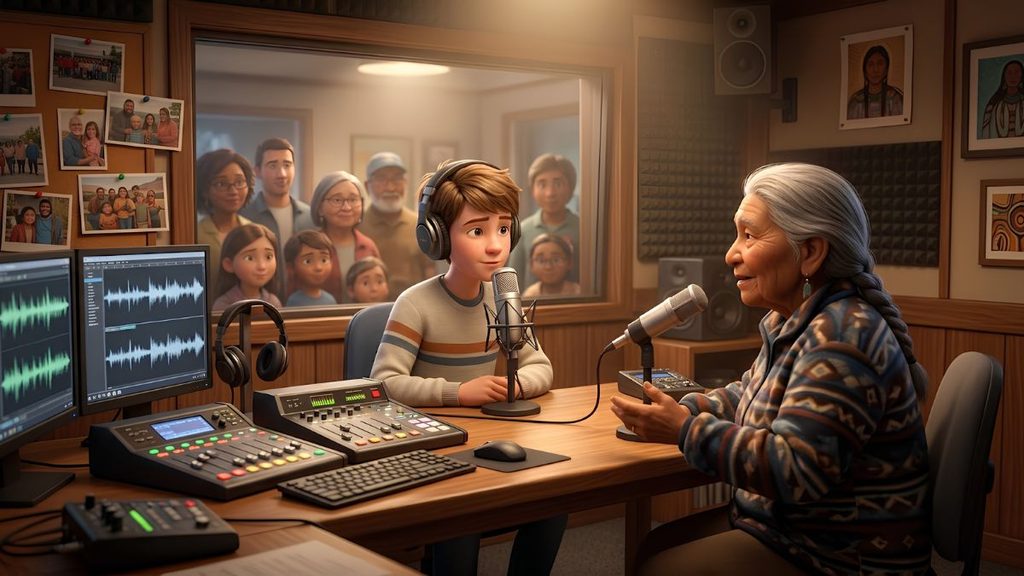
There were microphones.
Mixing equipment.
Computers.
A tiny recording booth.
Shelves of audio equipment.
A small studio with a window overlooking the hallway.
Lucas stared at everything.
“This is amazing.”
“It’s tiny.”
“That’s why it’s amazing.”
Elena laughed.
Learning the Equipment
Lucas expected Elena to put him behind a microphone immediately.
Instead, she gave him a notebook.
“First lesson.”
“What?”
“Listen.”
Lucas looked confused.
“I know how to listen.”
“Everyone thinks they do.”
She pointed toward the studio.
“Sit there for ten minutes.”
“Doing what?”
“Nothing.”
Lucas sat down.
For ten minutes, he listened.
He heard footsteps in the hallway.
A chair moving.
Someone laughing in another room.
A printer.
A distant car.
The hum of the air conditioner.
When the ten minutes were over, Elena returned.
“What did you hear?”
Lucas listed everything.
Elena nodded.
“Good.”
“Was that the lesson?”
“Part of it.”
“What was I supposed to learn?”
“That a recording contains more than words.”
Lucas thought about that.
She continued.
“Good storytellers pay attention.”
The following week, Elena taught him how to operate recording equipment.
Lucas learned how to check microphone levels.
He learned how to reduce background noise.
He learned how to label audio files.
He learned how to save recordings properly.
He learned that recording a conversation was very different from simply talking into a microphone.
Then Elena gave him another assignment.
“Interview me.”
Lucas grinned.
“Finally.”
“Don’t get excited.”
“I’ve been waiting for this.”
He turned on the recorder.
“Okay. First question. How did you become a radio host?”
Elena answered.
Lucas asked another.
Then another.
He felt proud.
When they finished, he played the recording.
It sounded terrible.
Lucas frowned.
“What happened?”
Elena smiled.
“You asked good questions.”
“Then why does it sound bad?”
“Because you were thinking about your next question while I was answering.”
Lucas became quiet.
“You weren’t listening.”
He understood.
Elena nodded.
“An interview isn’t a list of questions.”
“What is it?”
“A conversation.”
The Heritage Day Program
A few weeks later, the station began preparing a special program for American Indian Heritage Day.
The station wanted to feature local voices.
There would be interviews with elders, artists, students, educators, musicians, and community members.
Lucas immediately volunteered.
“I can produce it.”
Elena smiled.
“You can help.”
“Can I be the host?”
“We’ll see.”
Lucas began planning.
He wanted dramatic opening music.
He wanted a powerful introduction.
He wanted historical sound effects.
He wanted the program to feel important.
He wrote an introduction several pages long.
Then he showed it to Elena.
She read it.
“It’s dramatic.”
Lucas smiled.
“Thanks.”
“I didn’t say it was good.”
His smile disappeared.
“What?”
She handed the pages back.
“You’re telling the audience what to think before they hear anyone speak.”
Lucas looked confused.
“But it’s supposed to be a Heritage Day program.”
“Yes.”
“So it should sound important.”
“It will.”
“How?”
“By letting people tell their own stories.”
Lucas stared at the pages.
Elena continued.
“You don’t need to make someone’s story dramatic.”
“Why not?”
“Because their life is not a movie.”
The First Interview
Lucas’s first interview was with an elder named Thomas Gray.
Thomas had lived in the community for decades.
Lucas arrived with a notebook, recorder, headphones, and three pages of prepared questions.
Thomas smiled.
“That’s quite a collection.”
“I’m prepared.”
“I can see that.”
They sat beneath a tree outside the community center.
Lucas pressed record.
“Could you tell us about your childhood?”
Thomas began talking.
He described growing up near the river.
He talked about family gatherings.
He remembered his grandfather teaching him to recognize certain plants.
He described walking long distances to visit relatives.
Lucas listened.
He almost interrupted several times.
But he remembered Elena’s lesson.
So he waited.
Thomas continued.
Then he told a story Lucas hadn’t expected.
He described an afternoon when he and his cousins built a small shelter from branches.
They were proud of it.
Then a storm destroyed it.
The children were devastated.
Thomas laughed.
“At the time, we thought it was the end of the world.”
Lucas smiled.
“What happened?”
“We built another one.”
Lucas asked:
“Was it better?”
Thomas thought about it.
“Yes.”
“Why?”
“Because we knew what we were doing the second time.”
Lucas stopped writing.
That was the kind of sentence he would have never planned.
It wasn’t dramatic.
But he liked it.
The Artist
Lucas’s next interview was with a local artist named Sarah Whitecloud.
She created contemporary artwork inspired by family experiences, landscapes, and everyday life.
Lucas expected her to discuss traditional art.
Instead, she talked about modern life.
She talked about her phone.
Her studio.
Her children.
Her favorite music.
Her work.
Her community.
Her frustrations.
Her inspiration.
Lucas realized something.
He had expected her story to fit into a particular category.
But she didn’t.
She was simply a person with many interests.
At one point, Lucas asked:
“Do you think people sometimes expect Indigenous artists to only create traditional art?”
Sarah nodded.
“Sometimes.”
“How does that make you feel?”
She thought about it.
“It can be limiting.”
“Why?”
“Because culture is alive.”
Lucas waited.
She continued.
“We can honor where we come from while creating something new.”
Lucas wrote that down.
Then he realized he didn’t need to explain the meaning afterward.
Her words were enough.
The Student Interview
Lucas also interviewed students from the community.
One was a basketball player.
Another played guitar.
One was learning a heritage language.
Another wanted to become a veterinarian.
Lucas asked them about their lives.
Their favorite classes.
Their hobbies.
Their families.
Their dreams.
One student said:
“I don’t think being connected to your heritage means you have to live in the past.”
Lucas paused.
That sentence stayed with him.
He began noticing a pattern.
Everyone had different experiences.
There wasn’t one story.
There were many.
The Problem With the Introduction
As the program deadline approached, Lucas returned to his opening script.
He read it again.
It suddenly sounded wrong.
It was full of grand statements.
It talked about history.
Tradition.
Culture.
Identity.
Community.
But it barely mentioned actual people.
He walked into Elena’s office.
“I think my introduction is bad.”
Elena smiled.
“That’s progress.”
Lucas laughed.
“What should I do?”
“Ask yourself what the program needs.”
Lucas thought.
“People’s voices.”
“Exactly.”
“So I should delete it?”
“Most of it.”
He looked at the pages.
Then he smiled.
“Can I keep one sentence?”
“Which one?”
Lucas looked at his notes.
He chose:
“Every community is made of many voices.”
Elena nodded.
“That’s a good beginning.”
Recording Day
The station became busy.
Microphones were checked.
Audio files were organized.
Guests arrived.
Lucas helped prepare the recording schedule.
He checked levels.
He labeled files.
He monitored the equipment.
He wasn’t nervous anymore.
He was focused.
Before the broadcast, Elena asked:
“Ready?”
Lucas nodded.
“I think so.”
“Remember your first lesson.”
“Listen.”
She smiled.
The program began.
Lucas spoke briefly.
“Today we’re sharing stories from people in our community. These are not one story. They are many stories, told by many people.”
Then he stepped aside.
Thomas’s voice filled the studio.
He talked about his childhood.
Sarah spoke about art.
Students talked about school.
A musician discussed modern music.
A language learner described practicing new words with family members.
A teacher spoke about education.
There were moments of laughter.
Moments of quiet.
Moments when someone paused before answering.
Lucas didn’t remove those pauses.
He didn’t add dramatic music.
He didn’t try to tell listeners what they should feel.
He simply let the voices breathe.
A Different Kind of Storytelling
After the broadcast ended, Lucas removed his headphones.
The room became quiet.
He looked at Elena.
“That was different.”
“Yes.”
“Was it good?”
She smiled.
“Did you hear anything you hadn’t expected?”
Lucas nodded.
“Lots.”
“Then it was good.”
Lucas thought about all the people he had interviewed.
He had started the project wanting to tell their stories.
Now he understood that wasn’t quite right.
They had told their own stories.
He had simply created a place for them to be heard.
The Unexpected Message
The following week, the station received an email from a listener.
The listener said that one of the interviews had reminded them of a family member they had lost.
Another listener said they had enjoyed hearing a young student talk about modern life.
Someone else wrote that they had never realized how many different stories existed within the same community.
Lucas read the messages.
He was surprised.
“People really listened.”
Elena nodded.
“That’s what radio is for.”
A few days later, Lucas returned to school.
Mrs. Wilson asked how his project had gone.
“I helped make a radio program.”
“Did you learn anything?”
Lucas smiled.
“Yes.”
“What?”
He thought for a moment.
Then he said:
“I thought being a storyteller meant talking.”
Mrs. Wilson waited.
“Now I think it means listening.”
She smiled.
“That’s a very important lesson.”
The Little Studio
Lucas continued volunteering at the station.
He still loved technology.
He still loved microphones.
He still loved buttons.
But something had changed.
He no longer thought the microphone was the most important part of radio.
Sometimes the most important equipment was simply a quiet room.
A recorder.
And enough patience to let another person finish their thought.
He learned that communities weren’t made from one perfect story.
They were made from thousands of voices.
Some were loud.
Some were quiet.
Some belonged to elders.
Some belonged to children.
Some spoke about history.
Others spoke about school, art, sports, technology, family, music, work, and dreams.
Some stories looked backward.
Others looked forward.
And many did both.
Lucas understood that contemporary Indigenous life could not be reduced to a single image or a collection of historical facts.
It was lived every day by real people.
People who had memories.
Plans.
Problems.
Hobbies.
Families.
Careers.
Questions.
Dreams.
And stories of their own.
One evening, Lucas sat alone in the small recording booth.
The microphone was in front of him.
The headphones were on the table.
The station was quiet.
He pressed the microphone button.
Then he stopped.
For once, he didn’t speak.
He listened.
A distant voice laughed in the hallway.
Someone closed a door.
A car passed outside.
The air conditioner hummed softly.
Lucas smiled.
He finally understood Elena’s first lesson.
A radio station wasn’t simply a place where people talked.
It was a place where people listened to one another.
And sometimes, the strongest story wasn’t the one with the biggest introduction, the loudest music, or the most dramatic narration.
Sometimes it was simply a voice saying:
“This is what happened to me.”
And someone else caring enough to listen.
6. The Quilt of Many Names
Type: Community Art Story
Rose Martinez had one goal.
Her square had to be the best.
Not good.
Not pretty.
Not interesting.
The best.
She had already imagined exactly how it would look.
It would have a deep blue background with tiny silver stars. In the center would be a large tree with branches spreading toward the edges. Around the tree, Rose planned to stitch flowers, birds, leaves, and small geometric patterns.
She had even drawn the design three times.
The first version wasn’t symmetrical enough.
The second had too many empty spaces.
The third was almost perfect.
Almost.
Rose was twelve years old, and she loved art.
She especially loved projects where people could see what she had created.
At school, she was the student who stayed after class to add another detail to a drawing.
If someone complimented her work, she remembered it for weeks.
So when the community center announced a large public art project, Rose immediately wanted to participate.
She just hadn’t expected the project to teach her something about art that she had never considered before.
The Invitation
The announcement appeared on a sunny Saturday morning.
A large poster stood outside the community center.
OUR COMMUNITY, OUR STORIES
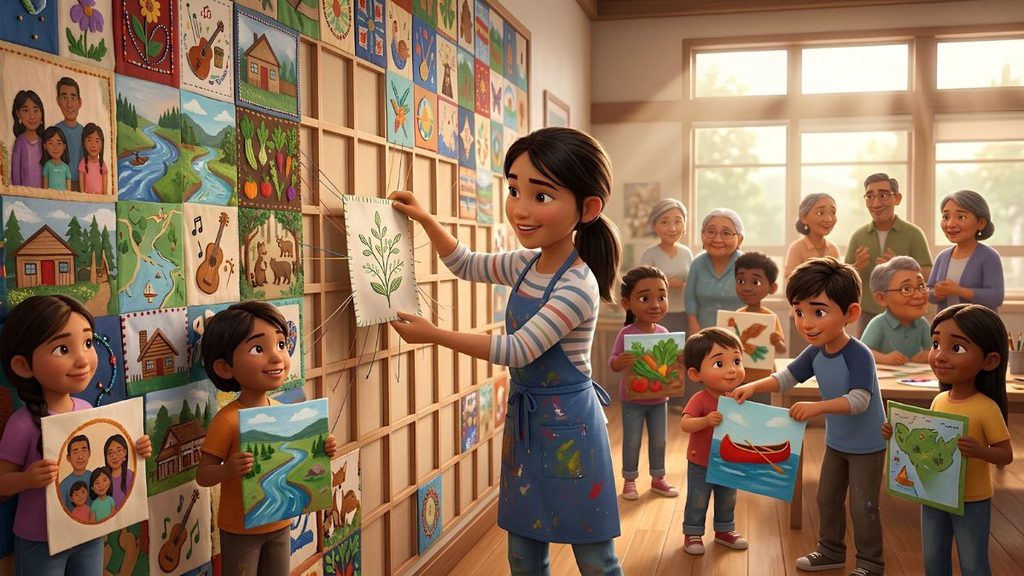
The project would create a huge quilt-inspired art installation.
Families throughout the community were invited to contribute one decorated square.
The squares would eventually be joined together and displayed on the wall of the community center.
Rose read the announcement twice.
“Can I do it?”
Her mother looked at her.
“You don’t need my permission.”
“I know.”
“Then why are you asking?”
Rose smiled.
“Because I want to know if you think I should.”
“I think you should.”
Rose immediately ran home for her sketchbook.
That afternoon, she began designing.
She drew a large tree.
Then she added stars.
Then flowers.
Then birds.
Then tiny patterns around the border.
Her mother looked over her shoulder.
“That’s beautiful.”
“Thank you.”
“What does the tree mean?”
Rose paused.
“I don’t know yet.”
Her mother smiled.
“You should probably figure that out.”
Rose frowned.
“Why?”
“Because the project is supposed to represent something meaningful.”
Rose looked at her drawing.
She had been so focused on making it beautiful that she hadn’t thought about what it meant.
Eventually, she decided the tree could represent family.
Its roots would represent the past.
Its branches would represent the future.
She wrote that in her notebook.
Then she went back to drawing.
The First Meeting
The children met at the community center the following weekend.
There were about twenty of them.
Some were younger than Rose.
Others were nearly teenagers.
Tables had been arranged in a large room.
Fabric, paint, thread, brushes, scissors, markers, beads, and other art materials covered the tables.
A woman named Elena, who was coordinating the project, stood at the front.
“Every square should tell us something.”
A boy raised his hand.
“Can it just be pretty?”
Elena laughed.
“Of course.”
“Good.”
“But if you want it to tell a story too, that’s even better.”
Rose looked at her sketch.
She felt confident.
Her design was already finished.
Then Elena said something else.
“There is one rule.”
Everyone became quiet.
“Your square isn’t supposed to compete with the others.”
Rose’s confidence disappeared slightly.
“What does that mean?”
Elena smiled.
“It means we’re making one artwork.”
Rose looked around.
One artwork?
That meant her square wouldn’t stand alone.
She wasn’t sure she liked that.
Everyone Has a Story
The first child to show their design was eight-year-old Liam.
His square had a bright yellow sun.
Around it were small green hills.
“My grandpa takes me hiking,” he explained.
“The hills are where we go.”
Another child had painted a red bird.
“My aunt taught me how to draw birds.”
A girl named Sofia had created a small blue house.
“This is the house where my parents met.”
Another child had drawn a basketball.
“This is my favorite place.”
Someone created a square filled with flowers.
“My grandmother’s garden.”
Another featured a river.
“My family goes there every summer.”
Rose listened.
Every square was different.
And every square had a reason.
She looked at her own design.
A beautiful tree.
Stars.
Flowers.
Birds.
It was attractive.
But suddenly it felt incomplete.
She had designed something impressive.
She hadn’t yet designed something personal.
Rose Changes the Tree
That evening, Rose sat at her desk.
She stared at the drawing.
She thought about the other children.
Liam’s hiking hills.
Sofia’s blue house.
The grandmother’s garden.
The river.
The basketball court.
Each design represented a memory.
Rose began thinking about her own.
She remembered Sunday mornings at her grandmother’s house.
The smell of warm bread.
The old wooden chair near the kitchen window.
A small plant that her grandmother had kept alive for years.
The sound of family members talking.
The photographs on the wall.
She looked at her tree.
Then she changed it.
Instead of a generic tree, she drew the small plant from her grandmother’s window.
It wasn’t impressive.
It was simple.
But it meant something.
Rose smiled.
Then she noticed something else.
Her square would eventually sit beside other squares.
She began thinking about how they could connect.
The Border
At the next workshop, Rose saw the other designs.
Some were bright.
Some were dark.
Some had straight lines.
Others had curves.
Some were carefully symmetrical.
Others looked as though younger children had created them.
Rose’s first instinct was to make her square stand out.
Then she remembered Elena’s words.
We’re making one artwork.
She looked at the empty spaces around her square.
She could create a border that connected with the neighboring pieces.
She drew small leaves extending toward the edges.
On one side, a leaf curved toward Liam’s hills.
On another, a flower pointed toward the garden square.
She didn’t copy their designs.
She simply created visual connections.
When Elena saw it, she smiled.
“That’s interesting.”
Rose waited.
“You’re thinking about the whole.”
Rose nodded.
“I think so.”
The Unexpected Problem
As the project continued, something went wrong.
The children couldn’t agree on how the squares should be arranged.
Some wanted the brightest squares in the center.
Others wanted family-related designs together.
One child wanted all the blue squares in one row.
Another wanted every square mixed randomly.
Rose had an idea.
“What if we arrange them by story?”
Everyone looked at her.
“How?”
“Maybe places together. Then people. Then memories.”
Elena shook her head gently.
“What happens if a square belongs to more than one?”
Rose thought about it.
“Then it doesn’t fit.”
“Exactly.”
Rose looked at the collection.
She realized there was no perfect category.
A family could also be a place.
A place could contain a memory.
A memory could involve a person.
Everything overlapped.
“Then maybe we shouldn’t organize them by category.”
“What should we do?”
Rose looked at the squares.
“Maybe we should organize them by how they connect.”
Elena smiled.
“That’s a much better question.”
Finding Connections
The children began moving the squares around.
They experimented.
A river square went beside a hiking square.
A family photograph connected with a house.
A garden connected with a flower.
A music square connected with another child’s drawing of a festival.
Rose’s square connected several pieces because the leaves along its border created a natural transition.
Nobody’s square disappeared.
Nobody’s story became less important.
Instead, the pieces helped one another.
Rose began seeing the project differently.
Her square didn’t need to be the most impressive.
It needed to help the whole artwork become stronger.
The Quilt Comes Together
Over several weeks, the children worked.
Some painted.
Some stitched.
Some glued.
Some changed their designs completely.
One little boy accidentally spilled paint across his square.
He was devastated.
“It’s ruined.”
Rose looked at the blue paint.
“It doesn’t have to be.”
“What do you mean?”
She helped him turn the spill into a river.
He added a tiny boat.
Suddenly, the mistake had become part of the story.
Another child became frustrated because her drawing didn’t look professional.
Rose told her:
“It doesn’t have to.”
The girl looked surprised.
“But yours is so detailed.”
Rose smiled.
“That’s because I like details.”
“What if I don’t?”
“Then don’t.”
The girl smiled.
The Names
Near the end of the project, Elena brought everyone together.
“We need one more thing.”
“What?”
“Names.”
Each square would include the first name or family name of the person or family who created it.
Rose wrote her name carefully.
Rose
She looked at the other squares.
There were so many names.
Some belonged to children.
Some represented families.
Some included grandparents.
Some were written in different styles.
Rose realized that the title of the project wasn’t only about the pictures.
It was about the people.
The artwork was literally a collection of names.
Each name represented someone who had contributed a small piece of their life.
The Day of the Unveiling
The completed artwork was enormous.
It covered almost the entire wall of the community center.
People gathered for the unveiling.
Families searched for their squares.
Children pointed proudly.
Parents took photographs.
Grandparents smiled.
Rose stood near the back.
She couldn’t immediately find her square.
Then she saw it.
The little plant from her grandmother’s window.
The leaves stretched toward the neighboring designs.
Her square was beautiful.
But not because it was more elaborate than the others.
It was beautiful because it belonged.
Rose’s mother stood beside her.
“Do you like it?”
Rose nodded.
“I love it.”
“Which square is your favorite?”
Rose looked across the wall.
“I don’t know.”
Her mother smiled.
“That’s probably a good sign.”
Rose laughed.
There was Liam’s yellow sun.
Sofia’s blue house.
The garden.
The river.
The basketball.
The music.
The family photographs.
The tiny drawings from younger children.
The careful designs from older ones.
Some were sophisticated.
Some were simple.
Some were messy.
Some were colorful.
Some were quiet.
None were identical.
And that was the point.
A Different Definition of Beautiful
A visitor stood in front of Rose’s square.
“I like this one.”
Rose smiled.
“Thank you.”
“What does it represent?”
“My grandmother’s plant.”
The woman looked closer.
“It’s lovely.”
Rose pointed toward the neighboring squares.
“But it’s supposed to connect with those.”
The woman followed the leaves with her eyes.
“I see.”
Rose smiled.
Then she understood something.
She had spent most of her life thinking about art as something an artist created.
Something finished.
Something judged.
Something compared.
But this project had shown her another possibility.
Art could also be a conversation.
One person’s idea could meet another person’s idea.
A color could continue into someone else’s design.
A shape could create a connection.
A story could sit beside another story without becoming less important.
Differences didn’t have to be problems.
They could be the reason the whole thing worked.
The Last Piece
There was one empty space near the bottom of the installation.
Elena had deliberately left it blank.
“What goes there?” someone asked.
“We’re deciding.”
The children gathered around.
Ideas came quickly.
A flower.
A star.
A heart.
A tree.
A house.
Then Rose suggested:
“Why don’t we leave it?”
Everyone looked at her.
“Leave it empty?”
“Yes.”
“Why?”
“Because there should always be room for another story.”
The room became quiet.
Elena smiled.
“I like that.”
So the empty space remained.
A small open square surrounded by dozens of completed pieces.
It became Rose’s favorite part of the entire installation.
Months later, people still visited the community center to see the artwork.
New families sometimes asked about it.
Children pointed to their relatives’ squares.
Visitors asked about the stories.
And occasionally, someone would notice the empty space.
“Why isn’t there anything here?”
A child would explain:
“Because there’s always room for another story.”
Rose liked hearing that.
She no longer worried about whether her square was the best.
She had learned that being part of something didn’t mean disappearing into it.
Her square was still hers.
Her story was still hers.
Her memories were still hers.
But they became more meaningful when placed beside the memories of others.
The artwork didn’t erase differences.
It celebrated them.
The little plant from her grandmother’s window sat beside a river, a house, a garden, a basketball, a musical instrument, family photographs, childhood drawings, and countless other symbols.
No two squares were exactly alike.
And yet they belonged together.
Rose finally understood why.
A community didn’t need everyone to have the same story.
It needed people willing to share their stories, listen to others, and find ways for different pieces to belong together.
The quilt was beautiful because of its differences.
Its many colors.
Its many memories.
Its many families.
Its many names.
And somewhere in the middle of all those different stories was Rose’s little square, connected to everything around it.
She smiled whenever she saw it.
Because she no longer wanted her art to be the most impressive thing on the wall.
She wanted it to be part of something bigger.
And that, she discovered, could be even more beautiful.
7. The Photograph With No Name
Type: Mystery & Historical Investigation
Elena Morales had always believed that old photographs were easy to understand.
You looked at the picture.
You saw the people.
You read the names.
Then you knew what you were looking at.
Her grandmother, however, disagreed.
“Photographs don’t tell you everything,” Grandma Rosa often said.
“They leave things out.”
Elena never understood what she meant.
Until the afternoon she found the photograph with no name.
The Old Photograph
It happened during a visit to her grandmother’s house.
Elena was thirteen and had been helping clean the upstairs hallway before a family gathering.
Grandma Rosa had lived in the same house for more than forty years.
The house contained boxes everywhere.
There were boxes of Christmas decorations.
Boxes of old letters.
Boxes of clothes.
Boxes filled with photographs.
Elena loved the photograph boxes most.
Whenever she found one, she sat on the floor and looked through it.
She had seen pictures of her mother as a child.
Her uncles at school.
Her grandmother as a young woman.
Family picnics.
Birthday parties.
Community gatherings.
Some photographs were carefully labeled.
Others weren’t.
That afternoon, Elena found a particularly old album inside a wooden cabinet.
She carried it downstairs.
“Grandma, can I look through this?”
Rosa glanced over.
“Of course.”
Elena opened the album.
The photographs became older as she turned the pages.
The colors faded.
The edges became worn.
Some pictures had handwritten notes.
Others had dates.
Then Elena found one that made her stop.
It showed a large community gathering.
There were dozens of people standing outside a long building.
Children stood in the front.
Adults stood behind them.
Some people were smiling.
Others looked serious.
Elena turned the photograph over.
Names had been written carefully across the back.
She recognized several family names.
But one person had no name.
Near the left side of the photograph was a young girl.
Underneath the picture, someone had written:
“Community Gathering, Summer 1974.”
Then came a list of names.
One.
Two.
Three.
Four.
Elena counted.
Everyone appeared to be identified.
Everyone except the girl.
“Who Is She?”
Elena carried the photograph to her grandmother.
“Grandma?”
“Yes?”
“Who is this?”
Rosa looked at the picture.
For several seconds, she said nothing.
Elena noticed the change in her expression.
“You know her?”
Rosa took the photograph carefully.
“I remember this day.”
“Who is the girl?”
Rosa looked closer.
“I don’t know.”
Elena blinked.
“You don’t know?”
“I was very young then.”
“But you know everyone else.”
“Some of them.”
Elena pointed to the girl.
“Why isn’t her name written down?”
Rosa shrugged.
“Maybe whoever labeled the photograph didn’t know it.”
“But she was there.”
“Yes.”
“Then someone must know.”
Rosa smiled faintly.
“Perhaps.”
That answer was not enough for Elena.
She looked at the photograph again.
The girl’s face was partially turned toward the camera.
She wore a simple dress and stood slightly apart from the other children.
There was something about her expression that made Elena curious.
She didn’t look unhappy.
She looked as though she were waiting for someone.
“Grandma, can I investigate?”
Rosa laughed.
“Investigate?”
“Yes.”
“Why?”
“Because somebody should know her name.”
Her grandmother looked at her for a moment.
Then she nodded.
“All right.”
The First Clue
Elena began with the obvious place.
The back of the photograph.
She copied every name into her notebook.
She also copied the date.
Summer 1974.
Then she wrote:
Unknown girl.
She drew a box around the words.
The next day, she asked her grandmother about the people in the photograph.
Rosa identified several.
“This was your great-uncle Miguel.”
“And this?”
“That was Mrs. Carter.”
“What about the man in the hat?”
“Mr. James.”
Elena wrote everything down.
“Was this a special event?”
“Yes.”
“What event?”
Rosa thought.
“It was a community gathering.”
“For what?”
“I can’t remember exactly.”
That was another problem.
Elena had a photograph.
She had a date.
She had names.
But she didn’t know what the gathering was.
The Family Albums
Elena searched through more albums.
She found another photograph from 1974.
Then another.
One showed several children standing near the same building.
The unidentified girl wasn’t there.
Another showed adults sitting at long tables.
Still no girl.
Then Elena found something interesting.
A photograph taken from a slightly different angle showed the same group.
The unknown girl was visible.
Elena placed the photographs side by side.
“Grandma!”
Rosa came over.
“Look.”
Elena pointed.
“In this photograph, she’s standing beside that woman.”
Rosa adjusted her glasses.
“That’s Mrs. White.”
“Do you know her family?”
“I did.”
“Could we find out?”
Rosa smiled.
“Now you’re becoming a detective.”
Searching the Newspaper
The next step was the local newspaper archive.
Elena’s grandmother took her to the public library.
A librarian helped them access old newspaper records.
They searched for community events from the summer of 1974.
There were hundreds of results.
School announcements.
Sports competitions.
Church gatherings.
Local meetings.
Fundraisers.
Community celebrations.
Elena read everything.
Nothing seemed connected.
After nearly an hour, she became frustrated.
“We’re never going to find her.”
Her grandmother shook her head.
“Historical research takes patience.”
“How much patience?”
“Sometimes more than you think you have.”
Elena laughed.
They continued.
Then they found an article.
It mentioned a community gathering held in July 1974.
The event had brought together families from several nearby neighborhoods.
Elena read the article carefully.
There was no photograph.
But there was a list of organizers.
One name caught her attention.
Margaret White.
Elena remembered the woman standing beside the unknown girl.
“Grandma!”
Rosa leaned over.
“I think we found something.”
Mrs. White’s Family
The librarian helped them search local records.
Margaret White had lived in the area for many years.
She had three children.
Two sons.
One daughter.
Elena stared at the information.
“Could the girl be her daughter?”
“Maybe.”
“But we don’t know her daughter’s name.”
They searched again.
Eventually, they found a record mentioning Margaret’s children.
The daughter’s name was Rose White.
Elena felt a rush of excitement.
“That’s her!”
Her grandmother raised an eyebrow.
“We don’t know that yet.”
“But it makes sense.”
“Yes.”
They needed more evidence.
The Old Address
The records showed that the White family had moved away years earlier.
Elena wondered how they could contact them.
The librarian suggested checking historical directories.
After more searching, they found an address for Rose White’s younger brother, Thomas.
He still lived in the same state.
Elena wrote a letter.
She explained the photograph.
She included a photocopy.
Then she waited.
Days passed.
Nothing.
A week passed.
Still nothing.
Elena began wondering whether the investigation had reached a dead end.
Then, one Saturday morning, her grandmother called from the front room.
“Elena!”
“What?”
“There’s a letter for you.”
Elena ran downstairs.
The Answer
The envelope had no return address she recognized.
Her hands trembled as she opened it.
Inside was a letter.
It was from Thomas White.
He remembered the photograph.
He remembered the gathering.
And he knew the girl.
Her name was Rose.
Elena stared at the page.
She had found her.
But the letter contained something else.
Thomas explained that Rose had been living with another relative at the time.
She had recently moved back to the area after spending several years away.
The community gathering had been one of the first times she had seen many relatives again.
“She was nervous,” Thomas wrote.
“She didn’t know many of the children there.”
Elena looked at the photograph again.
The girl’s expression suddenly made sense.
She hadn’t been waiting for someone.
She had been trying to find someone familiar.
Why Was Her Name Missing?
But Elena still had one question.
Why hadn’t anyone written Rose’s name on the photograph?
Thomas explained.
The person who labeled the photographs had assumed someone else would identify her.
Then the photograph was stored away.
Years passed.
The person who had intended to complete the label died.
The photograph moved between family members.
Eventually, no one remembered that the name had never been added.
“It wasn’t because she wasn’t important,” Thomas wrote.
“She was simply missed.”
Elena read that sentence several times.
She looked at her grandmother.
“That’s sad.”
Rosa nodded.
“History can lose people in very ordinary ways.”
Finding Rose
Thomas also provided contact information for Rose.
Elena’s grandmother helped her write a second letter.
This time, they included a copy of the photograph.
A few weeks later, a response arrived.
It was from Rose herself.
She remembered the day.
She remembered wearing the dress.
She remembered being nervous.
She remembered standing beside her mother.
And she remembered something Elena hadn’t expected.
She had been excited because she was meeting relatives she had never met before.
The photograph had been one of the few pictures from that day.
Rose wrote:
“I had almost forgotten that picture existed.”
Elena smiled.
She had spent weeks searching for someone who didn’t even know she had been missing from the record.
The Missing Name
Rose agreed to send Elena a photograph of herself as an adult.
She also sent a short note about her life.
She had become a teacher.
She had two children.
She still kept a few photographs from the 1970s.
And she remembered the community gathering fondly.
Elena added Rose’s name to her research notebook.
Then she carefully wrote it on a new archival copy of the photograph.
She did not write directly on the original.
Her grandmother had taught her that.
“Old photographs need to be treated carefully.”
Elena nodded.
She placed the original in a protective sleeve.
The copy went into a family history folder.
A Lesson About History
Elena’s school project was due soon.
She had originally planned to write about her family’s history.
Instead, she wrote about the photograph.
Her presentation began with a simple question:
Who gets remembered?
She showed the class the photograph.
Then she explained the investigation.
She talked about the date.
The names.
The newspaper.
The family records.
The letters.
The uncertainty.
The eventual discovery.
Her classmates were fascinated.
One student asked:
“How did you know the girl was Rose?”
“We didn’t at first.”
“Then how did you know?”
“We found evidence.”
Another student asked:
“Why didn’t they just know her name?”
Elena smiled.
“Because people forget things.”
The teacher nodded.
“That’s an important part of historical research.”
Elena continued.
“Records aren’t always complete. Sometimes names are missing. Sometimes dates are wrong. Sometimes people aren’t mentioned at all.”
She paused.
“That doesn’t mean they weren’t important.”
The Photograph Goes Back
Months later, Elena visited Rose’s family.
Rose brought out a small box.
Inside were old photographs.
Elena recognized several immediately.
There was the community gathering.
There was Rose as a child.
There was her mother.
There were family photographs Elena had never seen.
Rose laughed when she saw the picture.
“I remember that dress.”
Elena smiled.
“You looked nervous.”
“I was.”
“Why?”
“I didn’t know anyone.”
Elena looked at the photograph.
“You look brave.”
Rose laughed.
“I didn’t feel brave.”
“Sometimes you don’t have to feel brave to be brave.”
Rose smiled.
“That’s true.”
The Empty Space
When Elena returned home, she looked at the original photograph again.
The names were still written across the back.
She thought about how easily Rose’s name could have disappeared forever.
Not because of some great historical mystery.
Not because someone deliberately erased it.
Simply because someone thought another person would write it down later.
Elena realized that preserving history wasn’t always about discovering famous people.
Sometimes it meant remembering ordinary people.
A child at a community gathering.
A grandmother’s neighbor.
A teacher.
A musician.
A parent.
A family member.
People whose lives mattered even if their names never appeared in a newspaper headline.
She closed the photograph album.
Then she opened her notebook.
At the top of a fresh page, she wrote:
“Every photograph has a story. Sometimes you have to look carefully to find the missing part.”
A New Family Tradition
After that, Elena began recording family stories.
Whenever she found an old photograph, she asked her grandmother who was in it.
She wrote down names.
Dates.
Places.
Memories.
Sometimes her grandmother didn’t know.
Then they asked someone else.
If no one knew, Elena wrote:
Unknown.
But she didn’t stop there.
She understood now that “unknown” didn’t necessarily mean “unimportant.”
It simply meant there was more research to do.
Years later, the photograph of the community gathering remained in the family archive.
On the back was a carefully preserved list of names.
And among them was one name that had once been missing.
Rose White.
A single name.
Fourteen letters.
But those letters represented an entire life.
Elena sometimes looked at the photograph and wondered how many other pictures around the world contained people whose names had been forgotten.
She couldn’t find all of them.
But she could begin with the ones within reach.
She could ask questions.
She could listen.
She could check records.
She could preserve memories.
And she could make sure that when someone asked, “Who is she?”
there was an answer.
8. The Artist Who Painted Tomorrow
Type: Contemporary Art & Dreams
Daniel Reyes could make almost anything glow.
Give him a tablet, a digital pen, and a quiet afternoon, and he could turn an ordinary landscape into something that looked as though it belonged on another planet.
He could paint mountains beneath purple skies.
He could create cities filled with floating lights.
He could make rivers shimmer like ribbons of silver.
His favorite thing about digital art was that nothing had to remain still.
A painting could change.
A landscape could transform.
A tree could become a constellation.
A photograph could become a dream.
Daniel loved that freedom.
What he didn’t understand was why his family kept telling him to look backward.
The Old Art Box
Daniel was fifteen and had been drawing since he could hold a pencil.
His mother kept some of his earliest drawings in a cardboard box.
There were crooked houses.
Stick figures.
Animals with enormous eyes.
A spaceship that looked suspiciously like a potato.
Daniel hated looking at them.
“They’re terrible.”
His mother laughed.
“You were six.”
“Exactly.”
One evening, she brought another box from the closet.
This one was older.
Much older.
It belonged to Daniel’s grandmother.
Inside were photographs, sketches, pieces of fabric, postcards, and several small examples of artwork created by family members over the years.
Daniel looked through them.
Some featured landscapes.
Others showed plants, animals, homes, and everyday objects.
One drawing showed a river flowing through a valley.
Daniel studied it.
“It’s nice.”
His grandmother, Elena, smiled.
“Nice?”
“What should I say?”
“You could say beautiful.”
Daniel shrugged.
“It looks old.”
His grandmother laughed softly.
“It is old.”
“I mean the style.”
“What is wrong with the style?”
“Nothing.”
Daniel hesitated.
“It’s just not how people make art now.”
Elena looked at him.
“Are you sure?”
“Pretty sure.”
She smiled.
“Then perhaps you should show us how people make art now.”
Daniel didn’t realize it at the time, but that conversation would change the way he thought about creativity.
The Exhibition
A month later, Daniel’s school announced an art exhibition.
The theme was:
Where We Come From, Where We Are Going
Students were encouraged to create artwork exploring family, community, identity, place, history, or the future.
Daniel immediately knew what he wanted to do.
A digital painting.
He imagined a spectacular landscape.
A traditional-looking landscape in the foreground.
Modern buildings in the distance.
A glowing digital sky.
Maybe a satellite floating above everything.
He wanted the painting to show the connection between the past and future.
But there was one problem.
He didn’t actually know how to connect them.
He only knew that he wanted the final image to look impressive.
The First Attempt
Daniel began working.
He created a beautiful digital landscape.
There were mountains.
A river.
Trees.
A small community in the distance.
Above everything floated a futuristic city.
He added glowing lines between the old landscape and the modern skyline.
Then he showed it to his grandmother.
She looked at the screen.
“It’s beautiful.”
Daniel smiled.
“But?”
Elena laughed.
“Why do you think there is a ‘but’?”
“Because you paused.”
“I was thinking.”
“About what?”
She studied the image again.
“You’ve drawn what you think the past looks like.”
Daniel frowned.
“What does that mean?”
“You have an old-looking landscape.”
“Yes.”
“And a futuristic city.”
“Yes.”
“You’ve put them beside each other.”
Daniel nodded.
“That’s the idea.”
“But where is your family?”
Daniel looked at the painting.
He didn’t know.
Looking Closer
That weekend, Elena invited Daniel to sit with her.
She opened an old album.
“Tell me what you see.”
Daniel looked at the photographs.
“People.”
“Who?”
“My family.”
“Good.”
She turned another page.
“What else?”
Daniel looked carefully.
A photograph showed several people standing near a river.
Another showed a house.
Another showed a group of children.
Another showed someone working on a piece of artwork.
Another showed a family gathering.
Daniel noticed something.
The same places appeared repeatedly.
The river.
The hills.
A particular tree.
A path.
The old community building.
“These places keep showing up.”
Elena nodded.
“They mattered.”
“Why?”
“Because people remembered them.”
Daniel thought about that.
He had been treating heritage like a collection of old objects.
But perhaps it was also a collection of places, memories, relationships, and experiences.
A Different Question
Daniel returned to his tablet.
Instead of asking:
“What did the past look like?”
he asked:
“What places and memories matter to my family?”
He began drawing again.
This time, he used photographs as references.
He painted the river his grandmother remembered.
He included the hills his mother had described.
He added a tree that appeared in several old photographs.
But he didn’t copy the photographs.
He changed them.
The river flowed toward a modern town.
The old path became a glowing digital trail.
Family photographs appeared as small floating windows in the sky.
Daniel’s grandmother appeared in one.
His mother appeared in another.
Then Daniel added himself.
He drew himself holding a digital tablet.
He smiled.
“This is better.”
His grandmother looked at the screen.
“It feels like you.”
The Problem With Copying
At school, Daniel showed his art teacher the new version.
Mr. Carter studied it carefully.
“You’ve made progress.”
Daniel smiled.
“Really?”
“Yes.”
“What should I improve?”
Mr. Carter pointed toward the center.
“This section.”
Daniel looked.
“The old artwork?”
“You’re copying it.”
Daniel frowned.
“I’m trying to respect it.”
“Respect doesn’t always mean copying.”
Daniel remembered his grandmother’s words.
“What does it mean?”
“Understand why it matters.”
Daniel sat quietly.
Mr. Carter continued.
“Artists don’t preserve creativity by refusing to change. They preserve it by understanding what they have inherited and deciding what to do with it.”
Daniel looked at his artwork.
For the first time, he understood.
He didn’t need to recreate someone else’s art.
He needed to create his own response to it.
Starting Over
Daniel deleted part of the painting.
Then another part.
Then another.
Soon, the spectacular landscape he had spent days creating was gone.
His mother walked into the room.
“What happened?”
“I’m starting again.”
“You deleted everything?”
“Almost.”
She looked at him.
“Are you sure?”
“No.”
She laughed.
“At least you’re honest.”
Daniel started again.
This time, he began with a single river.
He painted it simply.
Then he added the landscape.
Then the community.
Then the old photographs.
Then modern technology.
He included a phone.
A laptop.
A satellite.
A digital map.
But none of those things were floating randomly in the picture.
They were connected.
The river flowed beneath the town.
The town connected to roads.
The roads connected to cities.
The cities connected to the wider world.
And above everything, Daniel painted a sky filled with stars.
The Family Conversation
One evening, Daniel showed the unfinished artwork to his family.
His grandmother looked at it for a long time.
“Why the stars?”
Daniel smiled.
“I don’t know.”
“Yes, you do.”
Daniel thought.
“Because they’re old, but we’re still looking at them.”
Elena smiled.
“That’s a good reason.”
Daniel pointed toward the river.
“And this is the place you’ve talked about.”
“And the tree?”
“My mom said it was always there.”
His mother nodded.
“And the digital lines?”
“That’s me.”
His father looked at the painting.
“So the whole thing is your family history?”
“Not exactly.”
“What is it?”
Daniel thought.
“It’s what I inherited and what I’m doing with it.”
His grandmother smiled.
“Now you understand.”
The Exhibition Approaches
The week before the exhibition, Daniel became nervous.
Other students were creating paintings, sculptures, photographs, animations, and installations.
Some were extremely impressive.
Daniel saw one student’s sculpture and thought:
Mine isn’t good enough.
Then he saw another student’s painting.
Mine isn’t as detailed.
Then another.
Maybe I should have started over again.
He almost changed everything.
But he remembered what his grandmother had said.
He wasn’t supposed to copy the past.
He wasn’t supposed to compete with everyone else’s artistic voice.
He was supposed to find his own.
So he left the painting alone.
The Exhibition Night
The school hall was crowded.
Parents walked from display to display.
Teachers talked with students.
Children pointed at artwork.
Daniel stood beside his digital display.
His painting was projected onto a large screen.
The river stretched across the image.
The old landscape blended gradually into a contemporary community.
Family photographs appeared like memories within the scene.
Modern technology connected the different elements.
And above it all was the night sky.
A younger student stopped.
“How did you make this?”
Daniel explained.
The student looked fascinated.
“Is that your grandmother?”
“Yes.”
“And that’s you?”
“Yes.”
“Why are you holding a tablet?”
“Because that’s how I make art.”
The student nodded.
“I like that.”
Daniel smiled.
“Thanks.”
The Unexpected Question
A visitor asked Daniel:
“Is this supposed to show the past or the future?”
Daniel paused.
Neither answer felt right.
“It’s both.”
The visitor looked confused.
Daniel pointed toward the river.
“This part represents memories from my family.”
Then he pointed toward the digital landscape.
“This part represents how I see the world.”
“And the future?”
Daniel pointed toward the stars.
“I don’t know what the future looks like.”
He smiled.
“That’s why I painted it as a sky.”
The visitor nodded.
“That’s an interesting idea.”
Daniel smiled.
He had never thought of himself as someone who could explain art.
But now he realized that his painting had given him something to explain.
What Daniel Finally Understood
After the exhibition, Daniel returned home.
He opened the old art box again.
This time, he didn’t think the drawings looked outdated.
He saw something different.
He saw people experimenting.
Trying.
Learning.
Creating.
He looked at the old river drawing.
Then at his own digital river.
They looked completely different.
But they were connected.
The person who had created the original artwork had seen the world through their own eyes.
Daniel had done the same.
Neither was more important because it was newer or older.
They were simply different voices separated by time.
A New Project
Several weeks later, Daniel started another digital artwork.
This one was smaller.
He created a digital landscape inspired by the stories his grandmother had shared.
But this time, he added something unexpected.
An interactive element.
When someone clicked on different parts of the landscape, photographs and recorded family memories appeared.
The river opened one story.
The tree opened another.
The old community building opened another.
Daniel called it:
Stories That Keep Moving
His grandmother looked at it.
“You’ve changed the old photographs.”
“No.”
Daniel smiled.
“I’ve connected them.”
The Artist Who Painted Tomorrow
Daniel eventually realized that he had been asking the wrong question.
He had spent months wondering whether modern art could belong beside traditional artistic heritage.
The answer was simpler than he expected.
They didn’t need to compete.
They didn’t need to look identical.
And one didn’t have to replace the other.
A family could remember the past while creating something completely new.
A young artist could inherit ideas without becoming a copy of the artists who came before him.
Culture could be remembered without being frozen.
Heritage could move forward.
Daniel looked at the digital landscape on his screen.
The river flowed toward the horizon.
Behind it were mountains and memories.
Ahead were roads, buildings, technology, and possibilities.
Above everything was the same sky.
The past was behind him.
The future was ahead.
And he was standing somewhere in between, holding a digital pen.
He smiled.
He finally understood what his grandmother had meant.
The goal wasn’t to paint yesterday again.
It was to understand yesterday well enough to imagine tomorrow.
And Daniel had discovered that his own artistic voice could be part of that future.
9. The Day We Learned to Listen
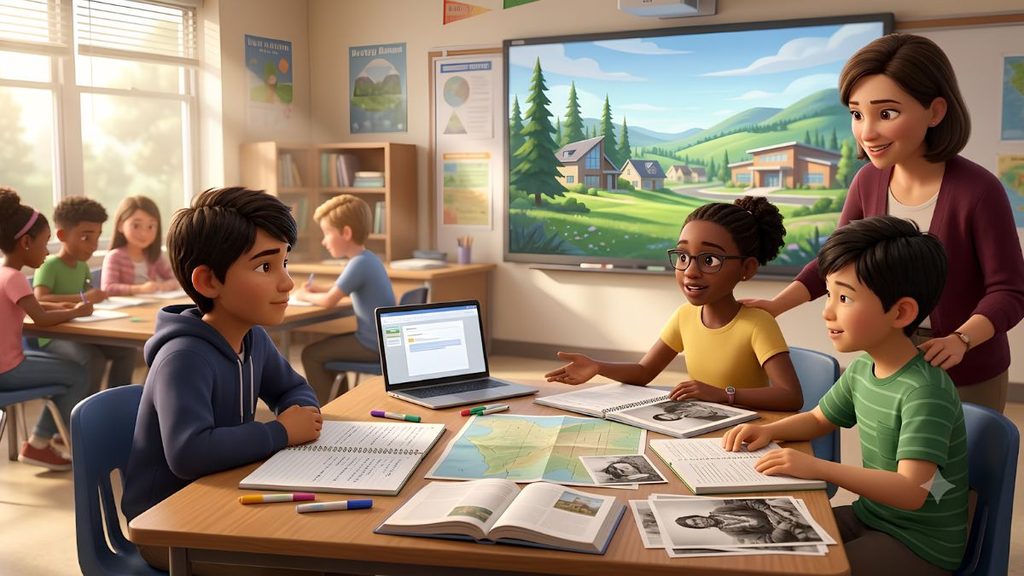
Type: Friendship & Cultural Respect
Eli Carter had learned to recognize the look.
It was the look people gave him when they were curious but didn’t know how to ask.
Sometimes it lasted only a second.
Sometimes it became a question.
Sometimes it became several questions at once.
He had experienced it before, but he had never quite figured out what to do about it.
That became especially difficult when Eli started at a new school.
He was twelve years old, and everything about the school seemed unfamiliar.
The hallways were longer than the ones at his old school.
The classrooms had different numbers.
The lunchroom was louder.
Even the bell sounded different.
Eli tried not to think about any of that.
He simply wanted to make friends.
He didn’t expect a history lesson to become the beginning of one of his most important friendships.
The New Student
On Eli’s first morning, his teacher introduced him to the class.
“Everyone, this is Eli. He’ll be joining us for the rest of the school year.”
A few students smiled.
One boy waved.
A girl near the window moved her backpack so Eli could sit beside her.
Her name was Noah.
She smiled.
“Hi.”
“Hi.”
“I’m Noah.”
“Eli.”
“I know.”
He laughed.
She laughed too.
It was a small beginning.
At lunch, Noah sat with Eli.
She asked about his old school.
He asked about the new one.
They discovered they both liked drawing.
They both disliked running laps.
And they both thought the cafeteria pizza tasted like cardboard.
Eli felt comfortable.
Maybe this school wouldn’t be so difficult after all.
The History Assignment
A few weeks later, their teacher, Mrs. Anderson, announced a new history unit.
“We’re going to study the history and cultures of Indigenous peoples in North America.”
Several students became interested immediately.
Eli listened quietly.
Mrs. Anderson continued.
“We’re going to focus on learning from reliable sources and understanding that there are many distinct Indigenous nations and communities.”
She wrote something on the board.
Many communities. Many histories. Many voices.
Eli liked that.
It sounded careful.
It sounded accurate.
Then she divided the class into groups.
Each group would research a specific Indigenous community and prepare a presentation.
Eli was assigned to a group with Noah, Jake, and Sophie.
At first, everything went well.
They searched library books.
They examined historical sources.
They compared information from different references.
Then Jake looked at Eli.
“Do you know about this stuff?”
Eli shrugged.
“A little.”
“Can you tell us what your people did?”
Eli froze.
“What do you mean?”
Jake seemed surprised.
“You know. Before America.”
Noah frowned.
“What do you mean by that?”
Jake shrugged.
“I don’t know.”
Sophie joined in.
“My family says Native Americans lived in teepees.”
Eli looked down at his notebook.
He knew she probably wasn’t trying to be rude.
But the conversation made him uncomfortable.
He didn’t know how to explain everything that was wrong with the question.
The Questions Continue
During the next class, the group continued working.
Sophie asked:
“Did your family live in a teepee?”
“No.”
“Did you hunt?”
“Sometimes people in my family hunt.”
Jake looked interested.
“Do you know traditional dances?”
Eli hesitated.
“Some.”
“Can you show us?”
Eli’s face became warm.
“I don’t really want to.”
Jake looked confused.
“Why?”
Eli didn’t answer.
Noah noticed.
She closed her notebook.
“Maybe we should just work on the project.”
Jake shrugged.
“Okay.”
But Eli was no longer comfortable.
The Question He Couldn’t Answer
That evening, Eli told his mother about the conversation.
She listened.
“Did they mean to hurt you?”
“I don’t think so.”
“How did you feel?”
Eli thought about it.
“Like I was supposed to know everything.”
His mother nodded.
“That’s difficult.”
“I didn’t know what to say.”
“You don’t have to answer every question.”
“But what if they’re just curious?”
“Curiosity isn’t wrong.”
She paused.
“But curiosity should come with respect.”
Eli thought about that.
His mother continued.
“You are one person. You don’t have to represent every Indigenous community, every family, or every tradition.”
Eli nodded.
“That’s what it felt like.”
“Then perhaps your teacher should know.”
Eli wasn’t sure.
He didn’t want everyone thinking he was complaining.
But the next morning, Mrs. Anderson noticed that he was unusually quiet.
A Private Conversation
After class, she asked:
“Everything all right?”
Eli hesitated.
“Can I tell you something?”
“Of course.”
He explained what had happened.
Mrs. Anderson listened without interrupting.
When he finished, she nodded.
“Thank you for telling me.”
“I’m not angry.”
“You don’t have to be angry for something to make you uncomfortable.”
Eli looked relieved.
Mrs. Anderson continued.
“I think we need to change how we’re approaching this unit.”
“How?”
“Instead of treating you as a source of information about Indigenous peoples, we’re going to treat you like every other student.”
Eli smiled slightly.
“Good.”
She smiled.
“And we’ll use specific, reliable sources to learn about specific communities.”
Eli nodded.
“That sounds better.”
The Classroom Discussion
The next day, Mrs. Anderson began class differently.
“I want to talk about something important.”
Everyone became quiet.
She explained that Indigenous peoples were not one single group with one culture, one language, one history, or one set of traditions.
“There are many distinct nations and communities,” she said.
“That means we should avoid assuming that something true of one community is automatically true of another.”
She wrote three words on the board:
Ask. Research. Listen.
Then she added:
Do not assume.
Jake raised his hand.
“What did we assume?”
Mrs. Anderson looked around the room.
“Sometimes people ask questions because they’re genuinely curious. But curiosity doesn’t give us permission to make another person explain an entire culture.”
The classroom became quiet.
Sophie looked at Eli.
He looked down.
Learning How to Ask
Mrs. Anderson gave the class examples.
Instead of:
“Do Native Americans believe this?”
Ask:
“What do reliable sources say about this particular community?”
Instead of:
“Do you do this tradition?”
Ask:
“Is this tradition associated with the community we’re studying?”
Instead of asking one Indigenous student to explain everything, use books, museums, archives, tribal sources, educators, and other reliable resources.
“Most importantly,” Mrs. Anderson said, “remember that asking someone about their personal experience is different from asking them to speak for millions of people.”
Noah raised her hand.
“So we can ask Eli about himself?”
“Yes, if he wants to answer.”
Everyone looked at Eli.
He smiled.
“That’s okay.”
An Apology
During lunch, Jake approached Eli.
“Can I talk to you?”
“Sure.”
Jake looked uncomfortable.
“I think I asked you some dumb questions.”
Eli smiled.
“A little.”
Jake laughed nervously.
“I’m sorry.”
Eli nodded.
“Thanks.”
“I really didn’t know.”
“I know.”
Jake kicked at a small stone on the pavement.
“I thought because you’re Indigenous, you would know everything about Native American history.”
Eli laughed.
“I don’t even know everything about my own family’s history.”
Jake laughed too.
“Fair enough.”
There was a pause.
Then Jake asked:
“So what do you actually like?”
Eli smiled.
“Drawing.”
“Seriously?”
“Yeah.”
“Me too.”
Eli looked surprised.
“What do you draw?”
“Cars.”
“I draw landscapes.”
Jake grinned.
“Show me.”
A New Friendship
After that, things changed.
Jake stopped asking Eli questions as though he were a textbook.
Instead, he asked about school.
Games.
Art.
Music.
Sports.
Movies.
Eli discovered that Jake was funny.
Jake discovered that Eli was extremely competitive at drawing challenges.
Noah joined them.
Soon the three became friends.
But the history project continued.
Their group researched a specific Indigenous community using reliable sources.
They learned about its history.
Its geography.
Its contemporary life.
Its community institutions.
Its art.
Its language.
Its historical experiences.
They learned that history was complicated.
There were achievements.
There were painful events.
There were stories of resilience.
And there were modern communities continuing to shape their own futures.
Eli’s Contribution
Eli decided he wanted to contribute something personal to the project.
Not as an expert.
Not as a representative of everyone.
Just as Eli.
He created a digital landscape.
It showed a modern community with houses, roads, trees, a school, a community center, and people going about their daily lives.
In the distance were hills.
Above the scene was a wide sky.
Jake looked at it.
“That’s really good.”
“Thanks.”
“What does it mean?”
Eli smiled.
“It means we’re still here.”
Jake nodded.
He understood.
Presentation Day
On presentation day, the group stood in front of the class.
Sophie explained their research.
Jake discussed the historical sources.
Noah talked about contemporary community life.
Then Eli showed his artwork.
“This is my part.”
He pointed toward the screen.
“I made this because when we were researching, I realized something.”
Everyone listened.
“There are a lot of stories about Indigenous people that focus only on the past.”
He paused.
“But Indigenous people live in the present too.”
He pointed toward the school in his artwork.
“There are students.”
Then the houses.
“Families.”
Then the community center.
“Community.”
He smiled.
“And people have futures.”
Mrs. Anderson nodded.
The Question at the End
When the presentation ended, the class applauded.
One student raised her hand.
“Can I ask Eli something?”
Mrs. Anderson nodded.
The girl looked at Eli.
“How do you know what is okay to ask?”
Eli thought about it.
“You don’t always know.”
The girl looked confused.
“So what do you do?”
“Listen.”
“To what?”
“To the answer.”
Eli continued.
“If someone doesn’t want to talk about something, don’t push.”
He smiled.
“And if you’re asking about history, research it.”
The classroom laughed gently.
Mrs. Anderson smiled.
“That’s an excellent answer.”
The Friendship That Followed
Weeks passed.
The history unit ended.
But the friendship didn’t.
Eli and Jake continued drawing together.
Noah joined them after school.
Sometimes they talked about serious things.
Sometimes they argued about which superhero was strongest.
Sometimes they simply sat together without talking.
One afternoon, Jake asked Eli:
“Do you think I was a bad friend?”
Eli looked surprised.
“No.”
“But I said those things.”
“You didn’t know.”
“So?”
“So you listened when you learned.”
Jake smiled.
“That’s good.”
“Yeah.”
What the Class Learned
The lesson stayed with everyone.
The students learned that respect wasn’t about knowing every fact.
It wasn’t about memorizing every tradition.
It wasn’t about treating another person as a representative of an entire culture.
Respect began with recognizing that people were individuals.
They learned to ask better questions.
They learned to research specific communities.
They learned to distinguish personal experience from historical evidence.
They learned that Indigenous cultures were not frozen in the past.
And they learned something about friendship.
A friend doesn’t need to understand everything about you immediately.
A friend doesn’t need perfect knowledge.
A friend simply needs to be willing to listen when you explain.
The Day We Learned to Listen
At the end of the school year, Mrs. Anderson asked the students what lesson they would remember most.
Answers filled the classroom.
“Check your sources.”
“Don’t believe everything online.”
“History is complicated.”
“Ask questions.”
Then Jake raised his hand.
“I think the biggest thing was listening.”
Mrs. Anderson smiled.
“Why?”
Jake looked at Eli.
“Because you can’t learn about someone if you’re already deciding what they’re supposed to be.”
The room became quiet.
Eli smiled.
He didn’t need to say anything.
For once, someone else had said it.
And perhaps that was the most important lesson of all.
Understanding another person didn’t begin with having all the answers.
It began with making room for their voice.
It meant asking respectfully.
It meant accepting that one person’s experience couldn’t represent everyone.
It meant learning from reliable sources.
And sometimes, it meant realizing that friendship could begin with something very simple.
A question.
An honest answer.
An apology.
And the willingness to listen.
10. The Cedar Box of Tomorrow
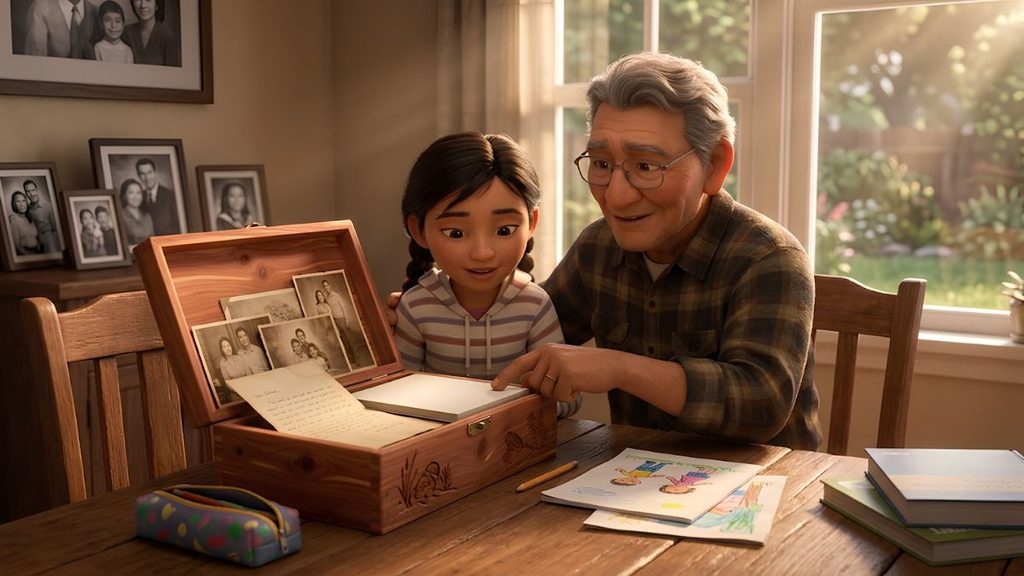
Type: Future, Family Legacy & Hope
Sarah had always thought of history as something that happened before she was born.
It lived in old photographs.
It belonged to stories told by grandparents.
It appeared in dusty boxes, faded letters, and pictures where everyone wore clothes that looked strangely formal.
History, Sarah believed, was behind her.
The future was somewhere ahead.
She never imagined that the two could belong in the same little wooden box.
That changed on a quiet autumn afternoon when her grandfather placed a cedar box in her hands.
The Box
Sarah was eleven years old and loved visiting her grandfather.
His house stood at the edge of a small town, surrounded by tall trees and a garden that seemed to grow in every direction.
There were vegetables near the kitchen window.
Flowers beside the porch.
A large old tree behind the garage.
And a narrow path leading toward a small hill where Sarah liked to sit and draw.
Her grandfather, Thomas, kept everything organized.
He labeled boxes.
He repaired broken clocks.
He carefully folded old letters.
He even had a notebook where he wrote down the dates when different plants in his garden first bloomed.
Sarah sometimes teased him about it.
“You write everything down.”
Thomas smiled.
“Someone has to remember.”
One Saturday afternoon, he called her into his study.
“I have something for you.”
Sarah looked at the table.
A small wooden box sat in the middle.
It was beautifully made.
The wood was warm brown, with a simple pattern carved into the lid.
Sarah ran her fingers across it.
“What’s inside?”
“Open it.”
She lifted the lid.
Inside were three things.
A collection of old photographs.
A folded handwritten letter.
And a completely blank notebook.
Sarah looked puzzled.
“Why is the notebook empty?”
Thomas smiled.
“Because it’s yours.”
The Photographs
Sarah picked up the photographs first.
The oldest showed a family standing outside a house.
The picture was faded.
Some faces were difficult to see.
“Who are they?”
“Your great-grandparents and their children.”
Sarah studied the photograph.
She recognized her grandfather as a young boy.
“You were so small.”
Thomas laughed.
“I was smaller than you.”
“Really?”
“Much smaller.”
Sarah picked up another photograph.
This one showed people gathered around a table.
“What were they doing?”
“Celebrating.”
“What?”
Thomas thought for a moment.
“A new beginning.”
Sarah smiled.
She liked that answer.
“What kind of new beginning?”
“I’ll tell you.”
He sat down beside her.
Stories Inside Pictures
Thomas began telling Sarah about the people in the photographs.
He explained where they had lived.
What work they had done.
Which relatives had moved away.
Which family members loved music.
Which ones were always telling jokes.
Which ones had been excellent cooks.
Which ones could never arrive on time.
Sarah laughed.
“I didn’t know that.”
“There are many things you don’t know yet.”
She looked at the photographs again.
The people suddenly seemed less like strangers.
They became individuals.
People who had laughed.
Worked.
Argued.
Celebrated.
Worried.
Dreamed.
And grown old.
Sarah had always thought family history was a list of names.
Now she realized it was made of ordinary lives.
The Letter
Sarah unfolded the handwritten letter.
The handwriting was careful and slightly faded.
“Who wrote this?”
“Your grandmother.”
Sarah looked surprised.
“I thought Grandma wrote mostly recipes.”
Thomas laughed.
“She wrote many things.”
Sarah read the first few lines.
The letter described a difficult year from decades earlier.
It talked about uncertainty.
Money being tight.
A house that needed repairs.
A child starting school.
And yet, the letter ended hopefully.
Sarah looked up.
“She knew things would get better?”
“She hoped.”
“Did they?”
Thomas smiled.
“Not immediately.”
Sarah looked back at the letter.
“Then why did she write this?”
“Because she wanted someone in the future to know that difficult times don’t last forever.”
Sarah thought about that.
She folded the letter carefully.
The Empty Notebook
Then she picked up the notebook.
It was completely blank.
Sarah flipped through the pages.
“Why did you give me this?”
Thomas didn’t answer immediately.
Instead, he asked:
“What do you think should go inside?”
“More old photographs?”
“Maybe.”
“More letters?”
“Perhaps.”
“Family history?”
“Certainly.”
Sarah nodded.
“I can write down what you tell me.”
Thomas smiled.
“You can.”
Sarah waited.
“But that’s not what I want you to do.”
She looked confused.
“What else is there?”
Thomas pointed toward the notebook.
“Your life.”
Sarah’s Question
“My life?”
“Yes.”
“But this is a family history box.”
“Exactly.”
Sarah frowned.
“I don’t understand.”
Thomas sat beside her.
“You think heritage is only about what happened before you were born.”
“Isn’t it?”
“No.”
He picked up one of the photographs.
“These people inherited stories from the generation before them.”
He pointed toward Sarah.
“And then they created stories of their own.”
Sarah looked at the blank notebook.
“So you want me to write about myself?”
“I want you to leave something for the people who come after you.”
Sarah became thoughtful.
“What would I write?”
“Whatever matters.”
The First Page
Sarah took the notebook home.
That evening, she placed it on her desk.
She opened to the first page.
Then she stared at it.
Nothing happened.
She picked up her pencil.
Put it down.
Picked it up again.
Still nothing.
She tried writing:
My name is Sarah.
She looked at the sentence.
It seemed boring.
She crossed it out.
Then she remembered her grandfather’s words.
Whatever matters.
So she started again.
Today Grandpa gave me a cedar box.
She continued.
She wrote about the photographs.
The letter.
The blank notebook.
And the strange feeling of being asked to write something for people she would never meet.
At the bottom of the page, she wrote:
I wonder what they will be like.
Then she closed the notebook.
Filling the Pages
At first, Sarah only wrote occasionally.
Then she began noticing things worth recording.
She wrote about the day her family planted a tree.
She wrote about her first school art exhibition.
She drew a picture of her grandfather’s garden.
She recorded one of his stories about childhood.
She added a photograph from her birthday.
She wrote about a rainy afternoon when the electricity went out and the whole family sat together telling stories.
Some entries were only a few sentences.
Others filled several pages.
The notebook slowly became a portrait of her life.
Not a perfect life.
A real one.
The Conversation
One evening, Sarah asked her grandfather something.
“Did you write things down when you were my age?”
Thomas laughed.
“No.”
“Why not?”
“I didn’t think anyone would care.”
Sarah looked surprised.
“Why?”
“Because ordinary days don’t seem important when you’re living them.”
Sarah understood.
She had written about things that seemed ordinary.
Her school lunch.
A funny conversation with her brother.
A rainy afternoon.
A broken bicycle.
A drawing she wasn’t happy with.
Yet now, looking back at those pages, they felt important.
“What if I forget them?”
Thomas smiled.
“That’s why you’re writing.”
A Page About the Future
One weekend, Sarah decided to write about the future.
She wrote:
When I am older, I want to…
Then she stopped.
She didn’t know.
She had ideas.
She wanted to travel.
Maybe become an artist.
Maybe become a scientist.
Maybe write books.
Maybe live somewhere near mountains.
Maybe return to her hometown.
She wasn’t certain.
So she wrote all of them.
At the end she added:
I don’t know which dreams will come true. That’s okay.
She closed the notebook.
The Cedar Box Travels Forward
Years passed.
Sarah grew older.
The cedar box stayed with her.
She added more photographs.
More letters.
More drawings.
More stories.
There were school achievements.
Family celebrations.
Difficult moments.
New friendships.
Travel memories.
A graduation photograph.
A picture from her first job.
Then another notebook.
Then another.
The original blank notebook was no longer blank.
It was full.
One evening, Sarah returned to her grandfather’s house.
He was older now.
His garden had changed.
Some of the trees were larger.
Some flowers were gone.
But the old wooden box remained.
Sarah placed the notebook inside.
Thomas looked at it.
“You filled it.”
“Completely.”
“What did you put in there?”
“Everything I thought mattered.”
He smiled.
“Then you did it right.”
The Question Sarah Finally Understood
Sarah sat beside him.
“Do you remember what you told me when you gave me the box?”
Thomas nodded.
“You said heritage isn’t just about the past.”
“That’s right.”
“I understand now.”
Thomas waited.
Sarah looked at the box.
“Every generation adds something.”
Her grandfather smiled.
“Exactly.”
Sarah realized that the photographs inside the box weren’t merely memories.
They were evidence of people who had once been the future.
When her great-grandparents were young, they couldn’t have known what their family would become.
When her grandfather was a boy, he couldn’t have imagined Sarah sitting beside him decades later.
And Sarah couldn’t know who would eventually open her notebook.
But she could leave something behind.
A New Generation
Many years later, Sarah had children of her own.
One afternoon, her daughter discovered the cedar box.
“What’s this?”
Sarah smiled.
“Something your great-great-grandfather gave me.”
“Can I open it?”
“Of course.”
Her daughter carefully lifted the lid.
She found photographs.
Letters.
Notebooks.
And a small collection of drawings.
“Who’s this?”
“That’s me.”
“You were little.”
Sarah laughed.
“I was your age.”
Her daughter picked up one of the old notebooks.
“Can I read it?”
“Yes.”
She began reading.
Soon she started laughing.
“Mom, you wrote about Grandpa’s terrible cooking.”
Sarah smiled.
“He was terrible.”
From across the room, her son called:
“Grandpa could hear you!”
Everyone laughed.
Adding Something New
Sarah’s daughter eventually opened a fresh notebook.
It was completely blank.
She looked at her mother.
“What should I put in it?”
Sarah smiled.
“What matters to you.”
Her daughter thought.
Then she began writing.
She wrote about school.
Her friends.
Her favorite song.
A drawing.
A dream.
A question she couldn’t answer.
A day she wanted to remember.
Sarah watched quietly.
She recognized the moment.
The same moment her grandfather had created years ago.
A blank page becoming a bridge between generations.
The Box of Tomorrow
The cedar box was no longer simply a container for old memories.
It had become something larger.
It held the past.
But it also held the present.
And because each generation added something new, it quietly held pieces of the future too.
Sarah finally understood what her grandfather had meant.
Heritage wasn’t a museum where everything had to remain untouched.
It was more like a river.
It carried stories forward.
Some things changed.
Some things remained.
New memories joined old ones.
New voices joined familiar ones.
And every generation had the opportunity to add another chapter.
Sarah looked at the cedar box sitting on the table.
The wood had become darker with age.
The edges showed small marks from years of handling.
It wasn’t perfect.
Neither was the family history inside it.
But that was what made it valuable.
It was real.
It contained ordinary lives.
Ordinary dreams.
Ordinary days.
And those ordinary things had become extraordinary simply because someone had cared enough to remember them.
Sarah closed the lid.
Tomorrow, her daughter would probably add another page.
And one day, many years from now, another child might open the box and ask:
“Who were these people?”
Someone would answer.
“They were your family.”
And perhaps that child would open a blank notebook and begin writing too.
Not only about where the family had come from.
But about where they were going.
Because the most meaningful family stories aren’t always the ones that look backward.
Sometimes they are the stories that leave a blank page waiting for tomorrow.
Why Stories Are Useful for American Indian Heritage Day
Historical information is important, but stories can make information more memorable.
A child might read a paragraph about the importance of community.
A story can instead show a young character helping an elder, learning a family tradition, or participating in a community activity.
Through storytelling, readers can encounter cultural ideas through characters and situations rather than simply memorizing facts.
Stories can help children understand
- Respect: Characters can demonstrate respect for elders, family members, community leaders, and cultural traditions.
- Responsibility: A story can show how individuals contribute to their families and communities.
- Connection to nature: Stories can explore relationships with land, animals, water, and the natural world without turning Indigenous traditions into stereotypes.
- Family history: A grandparent or elder character can share memories that connect younger generations with their heritage.
- Cultural preservation: Characters can work to preserve language, songs, crafts, photographs, recipes, or family stories.
- Resilience: Historical and contemporary stories can demonstrate how communities maintain their identities despite difficult circumstances.
American Indian Stories Should Represent Diverse Cultures
One of the most important principles when creating American Indian Heritage Day stories is recognizing diversity.
There is no single “American Indian culture.”
The United States is home to many distinct tribal nations and communities.
Their histories and traditions can differ significantly.
For example, cultural practices, languages, traditional clothing, ceremonies, foods, art forms, and relationships with particular landscapes can vary from one community to another.
Therefore, generic stories using phrases such as “the Native Americans believed…” can easily oversimplify complicated cultural traditions.
A better approach is to create stories around a specific fictional community or clearly identify the particular tribal nation when discussing real cultural information.
Different Types of American Indian Heritage Day Stories
A collection of free stories can include different genres and themes.
This makes the collection more interesting while allowing readers to encounter heritage from multiple perspectives.
1. Family Heritage Stories
Family stories can focus on grandparents, parents, children, siblings, and extended family.
For example, a child might discover an old photograph belonging to a grandparent.
The photograph leads to a conversation about the family’s history.
The child learns that heritage isn’t simply something found in history books.
It exists within families.
Possible lesson
Learning about your family’s history can help you understand who you are today.
2. Stories About Elders
Elders can play an important role in stories about cultural knowledge and family history.
An older character might teach a child something meaningful.
This could involve:
- A family craft
- A traditional food
- A story about an ancestor
- A language lesson
- A historical memory
- A community tradition
- An important family value
The focus should remain on the relationship between generations rather than treating the elder simply as a source of mysterious ancient wisdom.
3. Stories About Native Languages
Language is an important part of cultural identity.
A story might follow a child learning words from a family member.
Perhaps the child has grown up speaking mostly English and feels embarrassed about not knowing their family’s heritage language.
An elder patiently teaches them.
The child eventually understands that learning a language is not about becoming perfect immediately.
It is about reconnecting with family.
Such stories can encourage children to appreciate language preservation.
4. Stories About Traditional Arts
American Indian artists have created and continue to create remarkable forms of visual art, weaving, pottery, carving, beadwork, painting, jewelry, and other creative work.
A fictional story could follow a child learning an artistic tradition from a family member.
The story might emphasize:
- Patience
- Creativity
- Practice
- Family knowledge
- Artistic expression
- Cultural continuity
It is important, however, to avoid presenting sacred or culturally restricted objects as ordinary craft projects.
5. Stories About Community
Community can provide a strong foundation for children’s stories.
A young character might participate in a community event and initially believe that their contribution is too small to matter.
Perhaps they help prepare food.
Maybe they decorate a community space.
They could help an elder.
They might assist younger children.
Eventually, the child discovers that communities are built from many small contributions.
Possible lesson
Everyone has something valuable to contribute to their community.
6. Stories About Nature and Responsibility
Nature can provide an excellent setting for heritage stories.
A child might accompany a grandparent on a walk and learn about plants, animals, water, or seasonal changes.
The story can encourage environmental responsibility.
However, writers should avoid assigning generic spiritual beliefs to all Indigenous peoples.
Instead, the story should establish the fictional family’s or specific community’s relationship with the environment.
This creates a more respectful and believable narrative.
7. Historical Stories
Historical fiction can introduce children to important moments in American Indian history.
These stories can explore subjects such as:
- Indigenous communities before European colonization
- Encounters between Indigenous peoples and settlers
- Forced displacement
- Boarding schools
- Preservation of tribal identity
- Treaty history
- Community resilience
- Cultural revitalization
Historical stories should be age-appropriate but should not erase difficult parts of history simply to make the subject comfortable.
Children can learn that history includes both achievements and painful experiences.
8. Stories of Resilience
Resilience is an important theme, but it should be handled carefully.
Native American history includes enormous challenges.
Communities experienced displacement, violence, disease, restrictions on cultural practices, forced assimilation, and other forms of injustice.
Yet Indigenous communities and cultures continue to exist and evolve.
A resilience story can therefore focus on rebuilding, preserving traditions, strengthening families, and maintaining cultural identity.
The message should not imply that suffering is the defining characteristic of Native American life.
9. Contemporary American Indian Stories
American Indian Heritage Day stories don’t have to take place hundreds of years ago.
Contemporary Native American characters can be:
- Students
- Teachers
- Artists
- Scientists
- Athletes
- Musicians
- Entrepreneurs
- Parents
- Engineers
- Doctors
- Writers
- Community leaders
This is important because Indigenous peoples are part of modern American society.
A contemporary story can show a Native American child attending school, participating in sports, using technology, spending time with family, or exploring their heritage.
Heritage and modern life can exist together.
10. Stories About Cultural Preservation
Cultural preservation can create emotional and inspiring stories.
A child might discover that a family tradition is slowly being forgotten.
They decide to learn more about it.
Perhaps they record a grandparent’s memories.
Maybe they create a family archive.
They could help organize photographs.
Or they might encourage younger children to learn a traditional language.
The story can show that preserving culture doesn’t necessarily mean remaining in the past.
It can mean carrying meaningful traditions into the future.
The Importance of Avoiding Stereotypes
When writing American Indian Heritage Day stories, stereotypes should be avoided.
Some outdated portrayals reduce Indigenous peoples to:
- Feathers
- Tipis
- War paint
- Warriors
- Mystical elders
- Animal spirits
- “Tribal” costumes
- Generic spiritual beliefs
These images may appear familiar because they have been repeated in popular culture.
But they don’t accurately represent the diversity of Indigenous peoples.
A modern, respectful story should allow characters to have individual personalities.
A Native American child can be funny, shy, ambitious, curious, competitive, artistic, adventurous, nervous, thoughtful, or imaginative.
They should not exist solely to teach someone else about “Native culture.”
Avoid Treating Native Cultures as a Single Tradition
A common storytelling mistake is combining traditions from unrelated tribal nations.
For example, a fictional character might simultaneously use cultural elements associated with completely different communities without explanation.
This creates a generic version of Indigenous culture rather than representing a specific community.
When cultural details matter to a story, writers should identify their source and research carefully.
For fictional stories, it can sometimes be better to create a fictional family and focus on universal themes such as:
- Family
- Friendship
- Memory
- Generosity
- Responsibility
- Community
- Respect
while avoiding invented claims about sacred traditions.
Free Stories Can Encourage Further Learning
The value of free American Indian Heritage Day stories isn’t limited to entertainment.
A story can become the starting point for deeper learning.
After reading, children can research:
- A particular tribal nation
- A Native American artist
- An Indigenous language
- A historical event
- A Native-led organization
- A museum collection
- Contemporary Indigenous achievements
This turns storytelling into an educational experience.
Discussion Questions After Reading
Parents and teachers can use questions after a story.
Family
- What did the character learn from their family?
- Why were family memories important?
Community
- How did different characters help one another?
- What could you contribute to your own community?
Heritage
- What did the character discover about their heritage?
- Why is preserving traditions important?
Respect
- Did the characters make assumptions about one another?
- How could they learn more respectfully?
History
- What historical information did the story introduce?
- What would you like to learn more about?
How Parents Can Use These Stories
Parents can use free Heritage Day stories as part of family conversations.
After reading a story, they might ask children about their own family history.
Questions could include:
“Do we have an old family photograph?”
“What traditions do we have?”
“What stories have grandparents told us?”
“Are there family recipes that have been passed down?”
This allows children to understand that every family has a history worth exploring.
How Teachers Can Use Them
Teachers can incorporate stories into classroom activities.
For example, a story could be followed by:
- A research project
- A geography activity
- A family-history discussion
- A vocabulary lesson
- A creative writing exercise
- An art project
- A library research session
- A discussion about historical sources
Teachers should supplement fictional stories with reliable factual resources.
Fiction should not be presented as a substitute for historical documentation.
Why Accuracy Matters
Cultural storytelling carries responsibility.
A fictional story can introduce an idea creatively, but readers may assume that cultural details are factual.
This is especially important when writing about:
- Ceremonies
- Sacred objects
- Spiritual beliefs
- Traditional clothing
- Tribal histories
- Languages
- Historical events
Writers should research carefully and avoid inventing traditions and presenting them as authentic.
When possible, resources produced by tribal nations, Native scholars, museums, libraries, and reputable educational institutions can provide stronger foundations.
American Indian Heritage Day Stories Should Include Joy
Heritage stories don’t always need to be serious.
Children can enjoy funny, adventurous, imaginative, and heartwarming stories involving Native American characters.
A story could involve:
- A child preparing for a community event
- Siblings competing over who can help more
- A grandparent teaching a family skill
- Friends getting lost on a nature walk
- A school project going hilariously wrong
- A young artist discovering a new talent
- Children working together to solve a community problem
Joy is an important part of representation.
Native American characters should be allowed to experience ordinary childhood moments.
Common Mistakes to Avoid
When creating American Indian Heritage Day stories, avoid these approaches:
- Treating all Indigenous peoples as one group: Different tribal nations have different cultures and histories.
- Using stereotypes: Avoid reducing Native identity to costumes, feathers, mystical powers, or generic “warrior” imagery.
- Inventing sacred traditions: Do not create fictional ceremonies and present them as authentic Indigenous practices.
- Making historical suffering the entire story: History matters, but Native life is not defined only by tragedy.
- Ignoring contemporary life: Native Americans live modern lives and contribute to every part of society.
- Using vague cultural claims: Instead of saying “Native Americans believe…”, identify the specific cultural context when making factual claims.
- Turning Native characters into teaching devices: Characters should have their own personalities, goals, challenges, and dreams.
Creating a Strong Collection of Free Stories
A high-quality collection should include variety.
For example, an American Indian Heritage Day Stories Free collection could eventually include stories about:
- Family history
- Grandparents and grandchildren
- Native language
- Community responsibility
- Traditional arts
- Friendship
- Nature and conservation
- Historical resilience
- Contemporary Indigenous life
- Cultural preservation
- Generational memories
- School experiences
This creates a broader representation than a collection focused exclusively on traditional imagery or historical events.
The Importance of Respectful Representation
The strongest heritage stories don’t tell readers that one culture is mysterious or unusual.
Instead, they encourage readers to see people as individuals while appreciating the cultural traditions that shape their lives.
A good story can communicate:
“This family has a history.”
“This community has traditions.”
“This language matters.”
“These memories deserve to be preserved.”
“Different cultures can be appreciated without being reduced to stereotypes.”
These messages are valuable for children and adults alike.
Final Thoughts
American Indian Heritage Day stories free can be an engaging way to introduce readers to Indigenous history, culture, family, community, creativity, and contemporary life.
The most meaningful stories go beyond costumes and familiar stereotypes.
They present characters as complete human beings.
They can be funny, emotional, adventurous, educational, inspirational, or heartwarming.
They can explore a child’s relationship with a grandparent, a family’s treasured memories, the preservation of a language, a community project, a school experience, or the discovery of an important piece of history.
Most importantly, American Indian Heritage Day storytelling should recognize the diversity of Indigenous peoples and approach cultural details with care.
When stories combine respect, accurate research, strong characters, cultural specificity, and engaging storytelling, they can help readers develop curiosity rather than assumptions.
And that may be one of the most valuable purposes of heritage storytelling: not simply telling children what to think about another culture, but encouraging them to learn, listen, ask thoughtful questions, and appreciate the many histories and communities that make up the United States.